
The Evolution of the Ark of the Covenant: From Philistine Treaty to El to Yahweh
/
The Ark of the Covenant is one of those biblical objects that feels inevitable. Gold-covered box. Cherubim. Divine presence. Tablets of the law. The centerpiece of Israel’s sacred furniture. We picture it that way because the final form of the text trains us to.
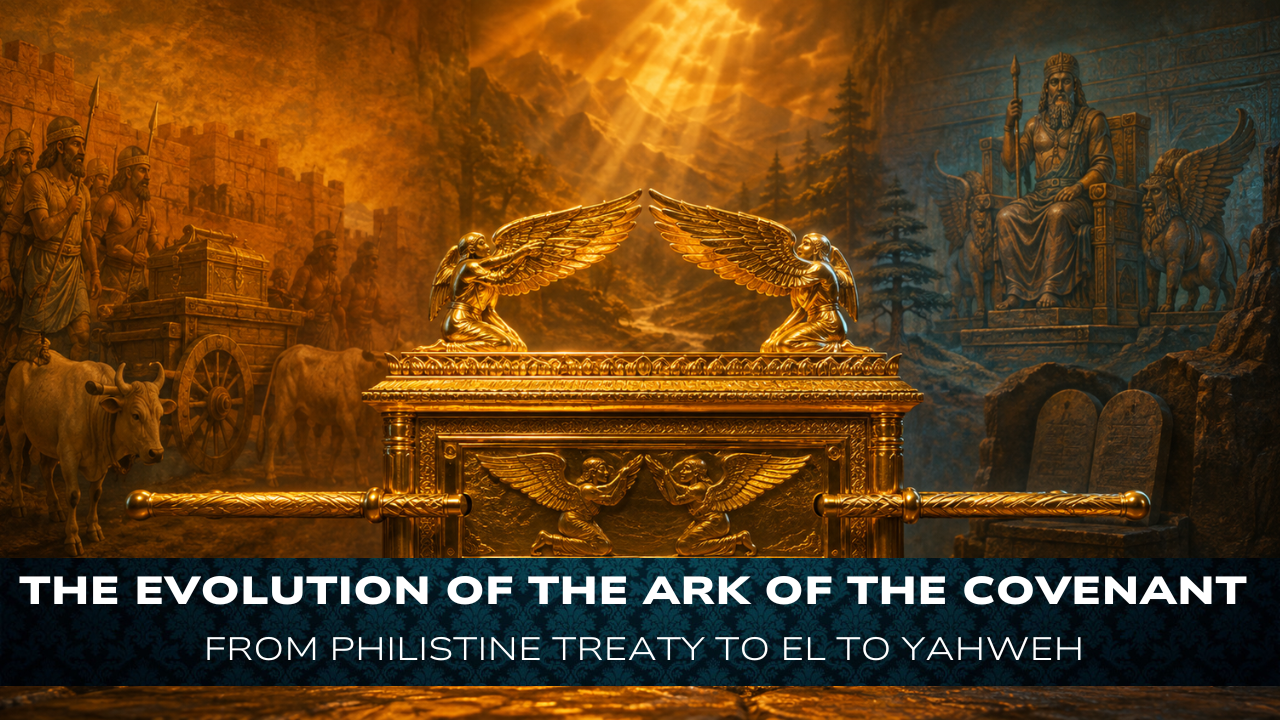
But the Ark did not start that way. Its history is a story of successive reuses, each layer overwriting the previous one while preserving just enough of the older narrative to leave fingerprints. What begins as a treaty chest ends as the throne of Yahweh. In between sits El.
We can reconstruct its evolution by reading the literary evidence the Bible itself preserves.
The Capture Story and Its Vocabulary
Start with the narrative many of you probably know: the Philistines capture the Ark. 1 Samuel 4–6 tells the story. Israel is defeated at Ebenezer. The elders decide to bring “the ark of the covenant of Yahweh” from Shiloh so that it may save them. Hophni and Phinehas accompany it. The Philistines are terrified, then win anyway. They take the Ark to Ashdod, then Gath, then Ekron. Tumors break out. Panic spreads. Finally the Philistines put the Ark on a new cart, hitch up two milk cows, and send it back toward Israelite territory. The cows head straight for Beth-shemesh. The leaders of the Philistines follow to the border.
That is the plot. The language is more interesting.
In large stretches of 1 Samuel 4–5 the object is not called “the ark of Yahweh.” It is called “the ark of Elohim.” (see my source attributions here)
“So the people sent to Shiloh, and from there they carried the ark of the covenant of Yahweh of hosts who sits above the cherubim… and the two sons of Eli, Hophni and Phinehas, were there with the ark of the covenant of God (Elohim).” (1 Sam 4:4, NASB)
Later: “When the ark of God (Elohim) came into the camp…” (4:6). “The Philistines took the ark of God and brought it…” (5:1–2). The phrase “ark of Elohim” or “ark of God” clusters in these chapters.
When the biblical authors want us to see Yahweh, they usually say Yahweh. When they shift to Elohim in a context that is otherwise highly particular, something else is often going on. In many cases the shift marks an earlier layer in which a different divine name stood. The later editor replaced the older name with the generic title Elohim rather than rewrite the entire scene (You can watch my video on this technique). The seams remain visible.
The capture story is one of those places. The presence of “ark of Elohim” is a signal that we are looking at material that once belonged to a different theological framework.
Psalm 78 and the Name Behind the Title
Psalm 78 retells the capture.
“And He gave up His strength to captivity
And His glory into the hand of the enemy.” (Ps 78:61, NASB)
The psalm pushes the idea that the ark was captured as well. But it also knows more. Look at the surrounding verses and the psalm’s overall orientation. It privileges northern traditions. It names Ephraim repeatedly and treats the northern tribes as the primary actors. It is not a Jerusalem-centered composition. Southern institutions and southern geography are secondary. (see my source attributions for the psalm here)
And the psalm is comfortable with El language. The ancient Canaanite high god El sits in the background of several of its divine titles and images. When a northern psalm that knows the Ark story also speaks the language of El, the simplest explanation is that the Ark in the earlier tradition was associated with El.
Before it was the Ark of Yahweh, it was the Ark of El.
That is the second stage. The first stage is older still.
Treaty Chests Were Ordinary Technology
Ancient Near Eastern diplomacy had standard furniture. When two parties made a treaty, the tablets or documents were often deposited in a chest and placed before the statue of a deity who served as divine witness. Hittite and Akkadian treaties regularly describe this practice. The chest was not magic. It was a container that made the agreement visible and placed it under divine oversight. The location, under the feet of the god’s image, signaled that the god enforced the terms.
Israel lived in that world. A wooden chest that held treaty documents was not a unique Israelite invention. It was international diplomatic hardware.
Now return to the broad circumstances of 1 Samuel 4–6. Israel suffers a military defeat. Shortly afterward the Philistines escort a sacred chest to a border town and hand it over. The narrative presents this as the Philistines desperately getting rid of a plague-bearing object. Historically, the shape of the scene looks like something else: the formal delivery of a treaty chest from the stronger party to the weaker one after a war.
The Israelites are the subservient party. The chest contains the terms of the arrangement. It ends up in an Israelite sanctuary because that is where the weaker party kept the documents that bound them.
Over time the political situation changed. The Philistines were no longer the dominant power. The old treaty was obsolete. Yet the chest remained. It was already sacred furniture. Throwing it out was not an option. The solution was reinterpretation.
How Propaganda Works
Biblical authors rarely invent entire episodes from nothing when an older story already exists. They keep the circumstances and change the meaning by adding a few decisive details.
The problem was obvious: everyone knew the chest had come from the Philistines. How do you turn a Philistine treaty box into the Ark of El?
You write a story in which the Philistines themselves decide they cannot stand to keep it. The object causes chaos in their temples. So they load it onto a cart pulled by unguided dairy cows and send it away, escorted by their own rulers only as far as the border. The Ark does not “come from” the Philistines in any intentional sense. It escapes them. The cows choose the road. Divine will, not diplomacy, returns the object to Israel.
The same basic events (military defeat, transfer of a chest, escorted delivery to a border town) now mean the opposite of what they once meant. Subservience becomes triumph. A treaty imposed by the stronger party becomes an object so powerful that the stronger party cannot tolerate its presence.
That is a classic propaganda technique: retain the memorable public facts and reverse their significance.
From El to Yahweh
The final stage is the integration of the Ark into the emerging Yahwistic national story. As the authors who were constructing a history of a united kingdom under David and Solomon worked, they absorbed older northern and local traditions. The Ark of El became the Ark of Yahweh. The older Elohim language was left in places, or partially updated. The object that once witnessed a treaty with the Philistines, then served as the chest of El, was now the footstool of Israel’s national god and the container of the tablets of the covenant with Yahweh.
Each stage leaves residue. The “ark of Elohim” phrases in 1 Samuel. The northern orientation and El language of Psalm 78. The oddly elaborate return narrative with the milk cows and the Philistine escort. The later insistence that the Ark belongs uniquely to Yahweh. None of these features is accidental. They are the literary scars of successive reclamations.
Why This Matters
The history of the Ark is a miniature of how much of the Hebrew Bible was made. Older materials were not discarded. They were reused. Names were changed. Meanings were inverted. Political realities that had become embarrassing were rewritten as theological victories. The final text attempts to present a smooth, continuous sacred history. Underneath it are the seams of earlier uses.
Recognizing those seams does not destroy the text. It explains how the text works. The Ark is powerful in the story precisely because it carries the weight of multiple earlier identities. What began as ordinary diplomatic furniture became, through successive acts of imaginative reclamation, the most charged object in Israel’s religious imagination.
The Philistines delivered a treaty chest. Later storytellers turned it into the Ark of El. Still later storytellers made it the Ark of Yahweh. The cows pulled the cart the whole way. The authors did the rest.