
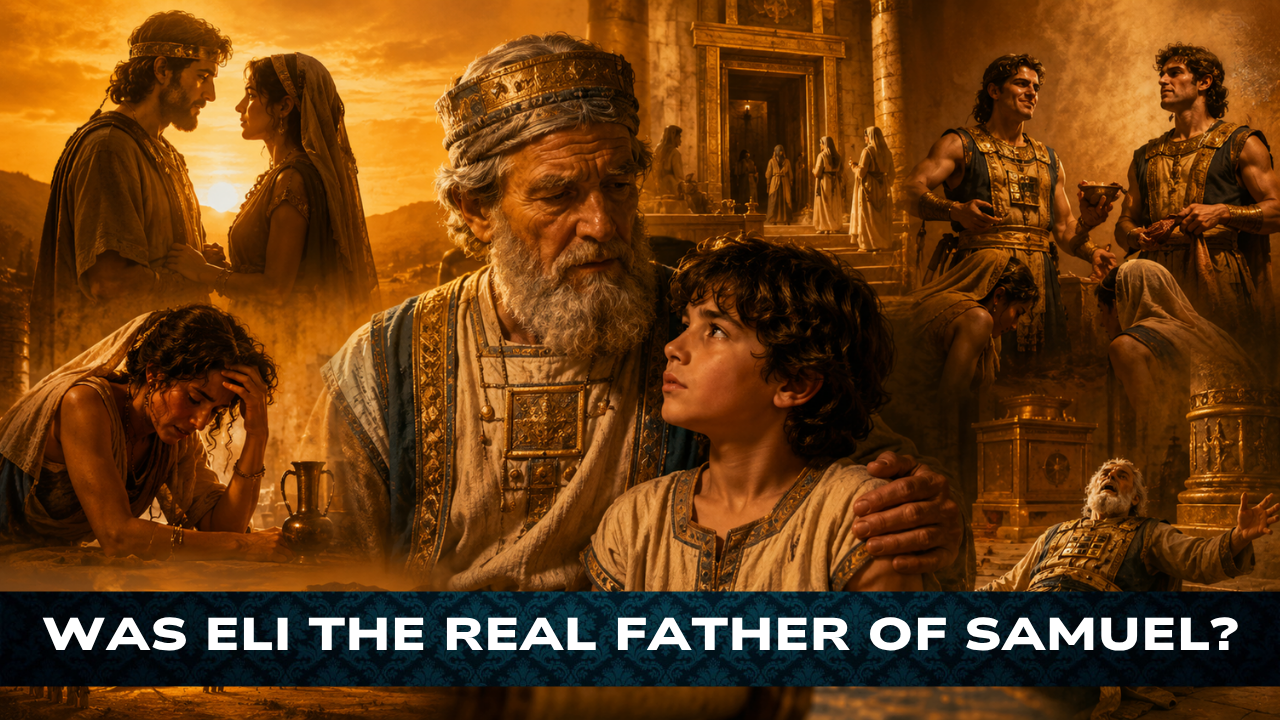
Was Eli the Real Father of Samuel?
/
Look, I know how this is going to sound. You’re going to roll your eyes, mutter something about conspiracy theories and people who spend too much time reading between the lines of ancient texts, and then go back to whatever respectable commentary you’ve got open. Fine. Do that. But while you’re at it, actually look at 1 Samuel 1 for a second without the Sunday-school filter welded over your eyes.
Because the story as we have it is doing some very familiar things. The biblical authors are excellent at this particular move: take a slightly awkward tradition, sand off the sharp edges, redirect the blame, emphasize the respectable relationships, age the problematic characters into sexless old men, and call it piety. We’ve seen the playbook before. Abraham and Sarah. David. The disciples on Pentecost. The technique is consistent enough that once you notice it, you start seeing it everywhere.
So let’s talk about Hannah, Elkanah, Eli, and the boy who ends up serving in the temple like he was born to it.
Husband and Wife, Loudly and Repeatedly
The text will not shut up about the fact that Hannah and Elkanah are married.
“And he had two wives: the name of one was Hannah and the name of the other Peninnah”
“Then Elkanah her husband would say to her”
“And Elkanah had relations with Hannah his wife”
“But Hannah did not go up, for she said to her husband”
“Elkanah her husband said to her”
He is her husband. She is his wife. The narrative keeps tapping us on the shoulder about it.
This is not neutral information. In biblical storytelling, when the author leans hard on a marital bond when something sexually charged is about to happen (or has already happened offstage), it is often a redirect. Remember Abraham and Sarah in Egypt and Gerar? The text insists they are married even while the foreign king is taking her into his house. The insistence is the point. It creates a protective layer of legitimacy so the reader does not draw the more obvious conclusion about how power, proximity, and fertility actually worked in those situations.
Same move here. Elkanah is the husband. Hannah is the wife. Therefore any child that appears must be Elkanah’s. The text is not describing reality so much as managing it.
“Your Maidservant”
Then Hannah opens her mouth in prayer and calls herself Yahweh’s “maidservant” three times in one verse (1 Sam 1:11). Later she does it again to Eli: “Do not consider your maidservant as a worthless woman” and “Let your maidservant find favor in your sight” (1:16, 18).
In the received reading this is pure piety. Humble woman, lowly posture, classic biblical self-deprecation. Except the language is the language of actual bond-service. “amah”. Female slave. The same word used for literal household servants and temple personnel in other contexts. The biblical authors are very good at taking vocabulary that was once concrete and spinning it into metaphor when the concrete version becomes inconvenient.
I am suggesting the metaphor is the secondary layer. Hannah was, in the underlying tradition, a literal bond-servant of the sanctuary at Shiloh, or of Eli’s household, or both. Temple service and household service blurred in that world. Women attached to the sanctuary existed. The text turns her status into spiritual poetry so we stop noticing the power differential.
Changing Hannah to a free married woman from the hill country of Ephraim changes the relationship dynamics completely.
The Drunk Woman
Eli sees Hannah praying, lips moving, no sound coming out, and concludes she is drunk. He tells her to put the wine away. She denies it: “I have drunk neither wine nor strong drink, but I have poured out my soul before the LORD” (1:15).
The narrative treats Eli’s diagnosis as a comic misunderstanding. Poor old priest, can’t tell the difference between prayer and inebriation. The text has to explain why a woman at the sanctuary looks and behaves like someone who has been drinking. The explanation is the redirect. We see the identical technique in Acts 2, where the crowd’s perfectly reasonable observation that the disciples are drunk at nine in the morning is overwritten with “they are filled with the Spirit.” The drunkenness is acknowledged as the surface reading and then re-described.
Hannah was drunk. That is the older layer. The prayer-and-soul-pouring is the literary fix. A drunk woman attached to the sanctuary, a slave to the high priest, is a different story than the one we are given. It is a story with fewer layers of piety and more layers of scandal.
The Accusation Already in the Text
The biblical authors are perfectly willing to accuse Eli’s sons of sexual exploitation of the women who served at the entrance of the tent of meeting (1 Sam 2:22). Hophni and Phinehas are the bad priests who take the best cuts of meat and sleep with the serving women. Eli is condemned for failing to restrain them.
Notice the shape of the accusation. The sexual misconduct is real in the tradition. It is simply assigned to the next generation. The father is only guilty of tolerance. That is a classic redirect. The sin is acknowledged, then displaced onto safer targets. Eli himself becomes the weak, aging father who should have done something, rather than the man with direct access and authority over the women of the sanctuary.
I am proposing the original charge was closer to home. Eli had sex with a drunk bondservant and she became pregnant with the boy who would later serve beside him. The sons inherit the accusation because the father’s version is too radioactive for the final form of the story.
Making Him Too Old
The text also works hard on Eli’s age. By the time we get to the later chapters he is old, nearly blind, heavy, and finally falls over backward and breaks his neck at ninety-eight. The narrative keeps reminding us he is elderly. Age is a useful narrative solvent. It dissolves sexual agency. We see the same technique with David in his later years: the old man in the bed, just needed a warm body and never had sex with Abishag (and therefore any offspring she did have couldn’t compete for the kingly line).
If Eli is already ancient when Hannah shows up, then of course he is not the father. The age is doing rhetorical work. It is time-shifting. An old Eli is a less obvious candidate to be someone who takes advantage of a drunk bond-servant.
Hiding in Plain Sight
Samuel ends up living at the sanctuary, raised by Eli, serving in the temple, sleeping near the ark, receiving the divine word that the old priest no longer receives. The boy is functionally Eli’s successor. The narrative explains this by having Hannah vow him to Yahweh before he is even conceived, then deliver him after weaning like a living sacrifice. It is a beautiful etiology. It is also an origin story designed to erase a more awkward one.
A child fathered by the high priest with a sanctuary servant would naturally grow up in the temple. No vow required. The dedication narrative is the invention that makes the arrangement look voluntary, pious, and initiated by the mother rather than produced by a scandal related to the sanctuary.
This is what I mean by hiding in plain sight. The pieces are all still there: the husband-and-wife insistence, the repeated “maidservant” language, the drunkenness that has to be explained away, the sexual accusations already floating around Eli’s household, the age markers, and the fact that the child simply belongs at Shiloh from childhood. The authors did not erase the scandal so much as rearrange it until it looked like devotion.
Is any of this provable in the forensic sense? Of course not. We are dealing with a carefully curated literary tradition, not a police report. But the techniques are the same ones the biblical authors use elsewhere when they need to manage inconvenient traditions about sex, power, and succession. They emphasize the legitimate marriage. They spiritualize the servant language. They reframe the drunkenness. They displace the sexual charge onto the sons. They age the father out of plausibility. And they invent a pious etiology for the child’s presence in the temple.
The result is the story we know: barren wife, faithful husband, answered prayer, dedicated son, prophetic career. It is a good story. It just may not be the only one the tradition ever told.
The scandal of Samuel is not unique in the biblical text. We’ve see this type of cover up before with Ruth’s pregnancy with Boaz.
Samuel served with Eli because he was Eli’s. The rest is the biblical authors doing what they do best: taking the messy human reality and turning it into something that supported their agenda.
And once you see that, the rest of the narrative snaps into focus as pure pro-Samuel propaganda. This is not neutral history; it is a carefully engineered campaign to install Samuel as the legitimate continuation of the priestly line while torching the competition. Hophni and Phinehas are written as cartoon villains, greedy, sexually predatory, doomed by divine oracle, so that their elimination (and the death of Eli himself) clears the stage completely. The ark is lost under their watch, the house of Eli is cursed, and the prophetic word shifts decisively to the boy who “grew in favor with the LORD and with men.” The story does not merely sideline Eli’s other sons; it obliterates them as viable heirs so that Samuel alone stands as the true successor. The pious origin tale, the redirected scandals, the aged father, the dedicated child serves that single political-theological goal: Samuel inherits the sanctuary, and the rivals are erased.