
Ezekiel 28: King of Tyre, or Satan?
/
Another Yahwist sandwich, like the one in my last post on Isaiah 14. This time it’s multi-layered. The seams in Ezekiel 28 are hard to miss once you look:
1–2a: Yahwist frame
2b–5: Poem about the leader of Tyre
6a: Yahwist
6b–10a: Continuation of the poem
10b–12a: Yahwist
12b–19: A different poem, also applied to the king of Tyre
In the Isaiah case I was suspicious that the poem belonged originally to the king of Babylon because it sat in the Yahwist layer. Internal evidence confirmed the suspicion and pointed toward Sargon II. Here the poems are labeled as addressing the “leader of Tyre” and then the “king of Tyre,” and they likewise sit in the Yahwist layer (I think). But this time there is no internal evidence supporting a reassignment away from Tyre. Quite the opposite. The references to sitting “in the heart of the seas”, to trade and to the Garden of Elohim make it reasonably certain that both poems were originally about the leader/king of Tyre.
A Hidden God
Most translations, however, obscure a key detail in that first poem: it references another god. That god is El. English versions typically render the relevant terms simply as “God” or “god,” which successfully papers over the fact that the Yahwist is taking a poem about El and making it about Yahweh by equating the two. The word translated “God” (Elohim) was probably originally El in those places; the biblical author was not comfortable leaving the older name standing in every instance and switched it out (see my video on this technique). The author has no problem with the leader of Tyre claiming “I am a god” (El), but when the text refers to the “seat of El” it becomes the “seat of Elohim.” The second poem, the one said to be about the “king of Tyre,” has the name of the original god (again, probably El) removed completely and replaced with Elohim.
This second poem is the one many Christians read, at least on some level, as a reference to Satan. I don’t think that’s the case. If we look more carefully at the text we can reconstruct a different tradition and see how it was layered onto the king of Tyre.
The Garden of Elohim
The Garden of Elohim (likely El originally) and the Garden of Eden were originally two different gardens that the biblical authors combined into one. The Garden of Elohim sits on a mountain with the giant trees, a clear reference to the cedars of Lebanon. See Ezekiel 31:8 where the great cedars were in the garden of God. In the ancient mind, giant trees of that sort marked a place for the gods. Eden, by contrast, is a well-watered, curated garden where Adam and Eve originate.
The phrase “Garden of Elohim” does not appear in Genesis (there we get “Garden of Yahweh” or simply “the garden”). But we do find a familiar character from Ezekiel 28 in Genesis: the guardian cherub. Claus Westermann notes:
“The description of the guardians who protect the access to the tree of life brings together two traditions. According to one they are the cherubim, according to the other “the flickering flame of a sword”; this is generally acknowledged.”
Claus Westermann, A Continental Commentary: Genesis 1–11 (Minneapolis, MN: Fortress Press, 1994), p.274.
I propose that “Eden” is an insertion in Ezekiel 28:13. Remove it and the poem still works; the meter even improves. There is also a clear parallelism in 31:8-9 that functions as a common propaganda technique to equate the two gardens.
The Guardian Cherub
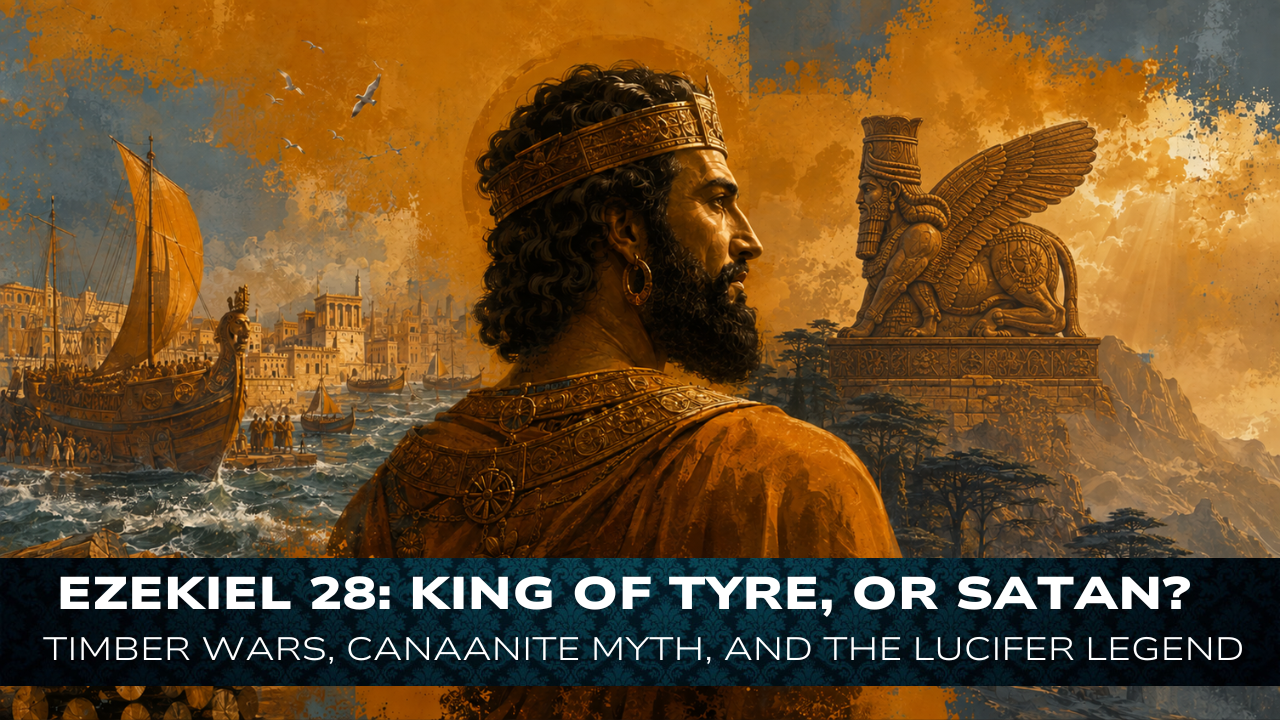
As with Isaiah 14, Ezekiel 28 is drawing on Canaanite mythic material. This is a natural metaphorical fit for the king of Tyre; no Satan is required. The king of Tyre controlled the timber trade in the Lebanon forest (the Garden of Elohim/El) until the Assyrians took control. We can place the original poem around the first time Tyre lost control of the Lebanon forests. After Tiglath-Pileser III, Tyre never regained that control. A figure who had once been imagined as a guardian cherub (or with it) of the divine mountain would no longer fit the historical reality.
This is interesting because it looks as though the Yahwist may have taken what was already a failed prophecy from one of the Assyrian sieges and repurposed it for the Babylonian siege of Tyre, which itself eventually became another failed prophecy. The layering is doing real work: an older poem about a Tyrian ruler who claimed (or was claimed) to sit in the seat of El, and who once controlled the sacred timber of the Lebanon forest, is being pressed into service against a later Tyrian king facing Babylon.
The second poem, with its cherub on the holy mountain and its expulsion from the garden of God, supplies the mythic depth. The Yahwist frame then redirects the whole complex to that siege happening at that time while quietly substituting Elohim for El and inserting Eden to bring the material into conversation with Israel’s other garden tradition.
None of this requires, or even particularly invites, a reference to Satan. The text is doing what biblical texts often do: taking older mythic and poetic material, sandwiching it between Yahwistic frames, adjusting the divine names so that Yahweh absorbs the older high god, and aiming the resulting composition at a concrete historical target. The king of Tyre is still the king of Tyre. In fact, the generic title may have replaced the original king’s name. The poem still works as a taunt against royal hubris and commercial arrogance.
The later Christian reading that turns the second poem into a biography of Satan is a classic case of reading later theological needs back into a text that was doing something more local, more literary, and more historically specific.
The Seams Reveal What the Text Is Doing
The sandwiches keep coming. Once you see the seams, the text becomes both more complicated and more interesting. The first poem keeps the maritime and commercial identity of Tyre front and center; the second poem elevates the same figure into the mythic register of the divine mountain and the covering cherub. The Yahwist does not erase either poem. He frames them, renames the deity where necessary, inserts a single word that yokes the mountain garden to Eden, and lets the resulting composition speak against the contemporary king. The result is not a fallen angel story. It is a carefully layered political and theological taunt that happens to preserve, almost by accident, traces of an older Canaanite tradition about El’s mountain and its guardian(s).
That older tradition makes excellent sense of the imagery without any need for a later dualistic figure. The king of Tyre metaphorically walks among the stones of fire on the holy mountain since he is the one who controlled it. Trade fills him with violence. He is cast down. The language of perfection, beauty, and wisdom is the language of royal ideology applied to a ruler whose power rested on control of the Lebanon timber. When that control was lost, the mythic claim collapsed with it. The Yahwist simply reused the collapsed claim for a new historical moment.
Readers who want Satan here will continue to find him. The text does not stop them. But the text itself is doing something else: it is sandwiching older poems, adjusting divine names, and aiming the result at Tyre. The seams are still visible.