
Lucifer: Satan, King of Babylon, or Sargon II?
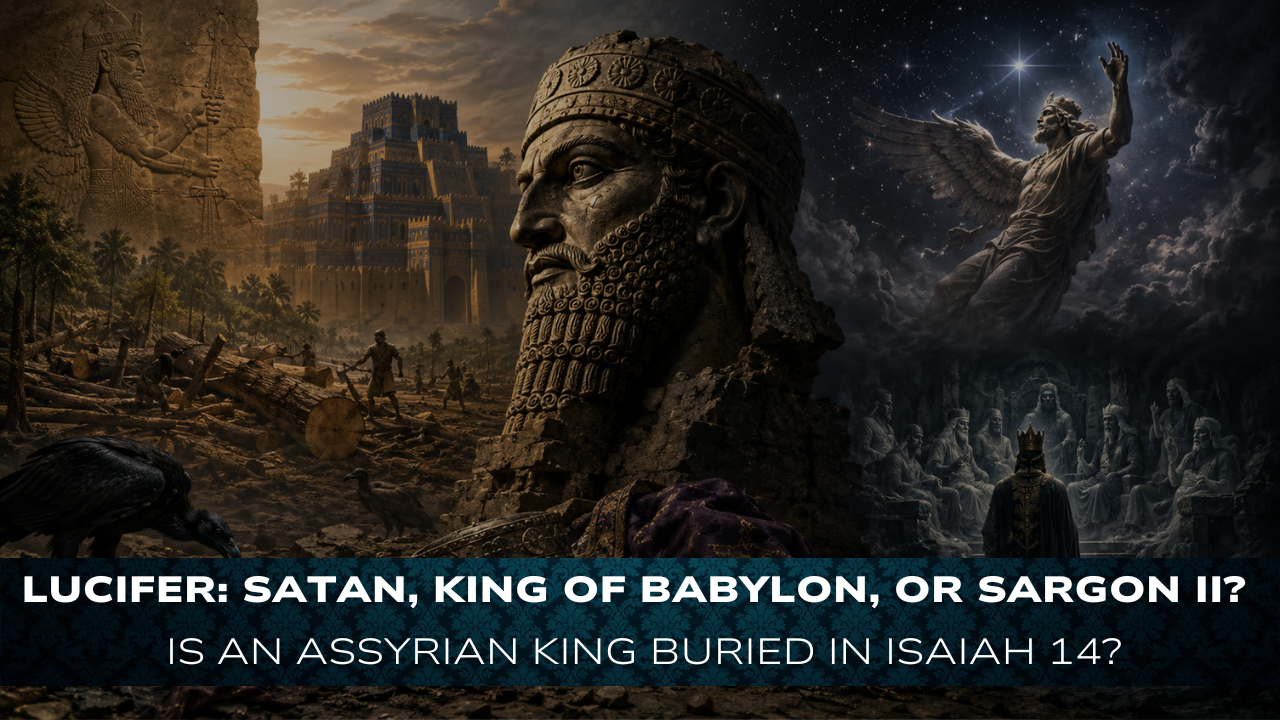
/
Is an Assyrian king buried in Isaiah 14?
Or rather: is an Assyrian king not buried there?
Let’s start where the text actually starts, not where later Christian tradition decided it should.
Isaiah 14:1-22 centers around a taunt song. A mock dirge. The kind of thing you sing when a tyrant finally gets what was coming to him and you want the whole neighborhood to hear it. The superscription says it’s against the king of Babylon. Fine. That’s what the final form of the text claims.
But biblical authors had a habit I’ve come to call the “Yahwist Sandwich”. They take material about some other god, some other myth, and wrap it in references to Yahweh at the beginning and the end. Suddenly the old story is about Israel’s god. Or about Israel’s enemy. The filling stays mostly the same; the bread makes it kosher.
Here the attribution to the king of Babylon sits right at the top of the sandwich. That alone makes me suspicious. If it were original to the text, it wouldn’t be in the Yahwist layer. So I read the poem itself and looked for the bits that refuse to fit a Babylonian king. One of them jumps out immediately.
An Unburied King
Isaiah 14 insists that this particular king never got a proper burial. He is cast out of his tomb like a rejected branch, clothed with the slain, a trampled corpse that does not join the other kings in their graves. All the other kings of the nations lie in glory, each in his own tomb. This one does not.
That is not what happened to any of the famous kings of Babylon. Nebuchadnezzar died in his bed, was buried with full honors, and stayed buried. Belshazzar’s end is murkier, but the biblical and later traditions do not fixate on an unburied corpse. The detail is specific, almost obsessive. It is the punchline of the mockery.
It is, however, exactly what happened to Sargon II of Assyria.
Sargon died on campaign in 705 BCE, somewhere in Anatolia, fighting the Cimmerians or whoever the annals are trying not to name too clearly. His body was never recovered. He was not buried in his house.
His son Sennacherib treated the whole affair as a religious catastrophe. Later Assyrian texts still wrestle with the fact that the king who built an entire new capital, Dur-Sharrukin, ended up as an unburied ghost. The poem in Isaiah 14 seems to have been one attempt to explain why Sargon II had such a shameful end.
The Rest of the Text Could Fit Either
Once you stop forcing every line to be about the king of Babylon (or Satan), the rest of the poem becomes more interesting rather than less.
A Strategic Forest
The trees of Lebanon rejoice because the one who used to cut them down is gone. Both the Assyrian and Babylonian kings took a proprietary interest in the cedars and junipers of Lebanon. Control of those forests was strategic, economic, and prestige-laden. The areas surrounding Lebanon lacked timber and empires sought to control access to it. The poem’s botanical celebration works for either empire. It does not decide the question.
Parallel to Helel
And then there is Helel ben Shahar. The “Shining One, son of Dawn.” The Latin tradition turned that into Lucifer, and Christian readers ever since have been unable to see anything but Satan falling from heaven. That reading is late, secondary, and frankly a bit lazy. The Hebrew is doing something older and more interesting.
We have Ugaritic material about divine beings who try to climb too high and get slapped back down. Athtar tries to sit on Baal’s throne and can’t fill it. There are dawn and morning-star figures floating around the Canaanite pantheon. The poem references the Canaanite god, El as well. The poem in Isaiah is likely referencing a story that existed that was derived from a Canaanite tradition and draped it over a human king. The parallel of hubris could be leveled against either the Babylonian or the Assyrian. But the specific detail of the unburied body tips the scale toward Sargon. The mythic language is the filling of the sandwich. The historical corpse is what makes the sandwich point at a particular meal.
Visit to Sheol
The middle of the poem is a visit to the underworld. Sheol is stirred up to meet the new arrival. The Rephaim, the shades of the dead kings, rise from their thrones to greet him. They are not particularly impressed. “You too have become as weak as we are. You have become like us.” Maggots are your bed; worms your covering.
I recently watched The Odyssey, and this scene felt familiar. Odysseus goes down to the land of the dead and is met by the shades of his fallen comrades. The Isaiah poem is doing something similar, only meaner. The dead kings are not comrades; they are the previous victims of the same imperial machine. They get to watch the latest model of tyrant arrive in the same degraded state they themselves occupy. No special treatment. No royal burial. Just the same maggot mattress as everyone else.
Both a Babylonian and an Assyrian king would, in the cultural imagination of the time, have gone to Sheol at death. That is not distinctive. What is distinctive is the insistence that this particular king arrives without the honor that even the other dead kings managed to retain. The poem is not interested in abstract theology of the afterlife. It is interested in the politics of humiliation.
Putting the Sandwich Back Together
So what do we have? A poem that uses Canaanite mythic language about a shining one who tried to climb too high. A poem about an unburied corpse. A poem that celebrates the relief of Lebanon’s forests. A poem that stages a bitter reception in the underworld. And then, wrapped around all of it, a prose frame that sprinkles in the name of Yahweh says “this is about the king of Babylon.”
The simplest explanation is the Yahwist Sandwich (you can see my source attributions here). An older taunt aimed at Sargon II got reframed when Babylon became the more recent oppressor. The filling still tastes like Assyria. The bread says Babylon. Later readers, especially Christian ones, decided the filling was actually about Satan and the bread was just packaging. That reading has had an extraordinarily successful afterlife. It is also not what the Hebrew text is doing.
None of this requires us to pretend the poem is pure reportage. It is poetry. It is propaganda. It is the literary equivalent of dancing on a grave that never quite got dug or simply an explanation for why such a great king was humiliated by not being buried. But if we are going to read it from a historical-critical lens rather than as systematic theologians looking for prooftexts, we have to let the awkward details speak. The unburied king is the most awkward detail of all. Babylonian kings got their tombs. Sargon did not. Isaiah 14 knows which one it is singing about, even if the final editors preferred a different name on the sandwich board.