
Was Saul Among the Prophets? How a Saying About Saul Got Two Fake Origin Stories
/
The saying “Is Saul also among the prophets?” shows up twice in 1 Samuel, each time with its own tidy little origin story. And if you’ve spent any time with the books of Samuel, you already know what’s coming: the text is doing that thing it does. The thing where it tells you the same story twice, slightly differently, and expects you to just… roll with it.
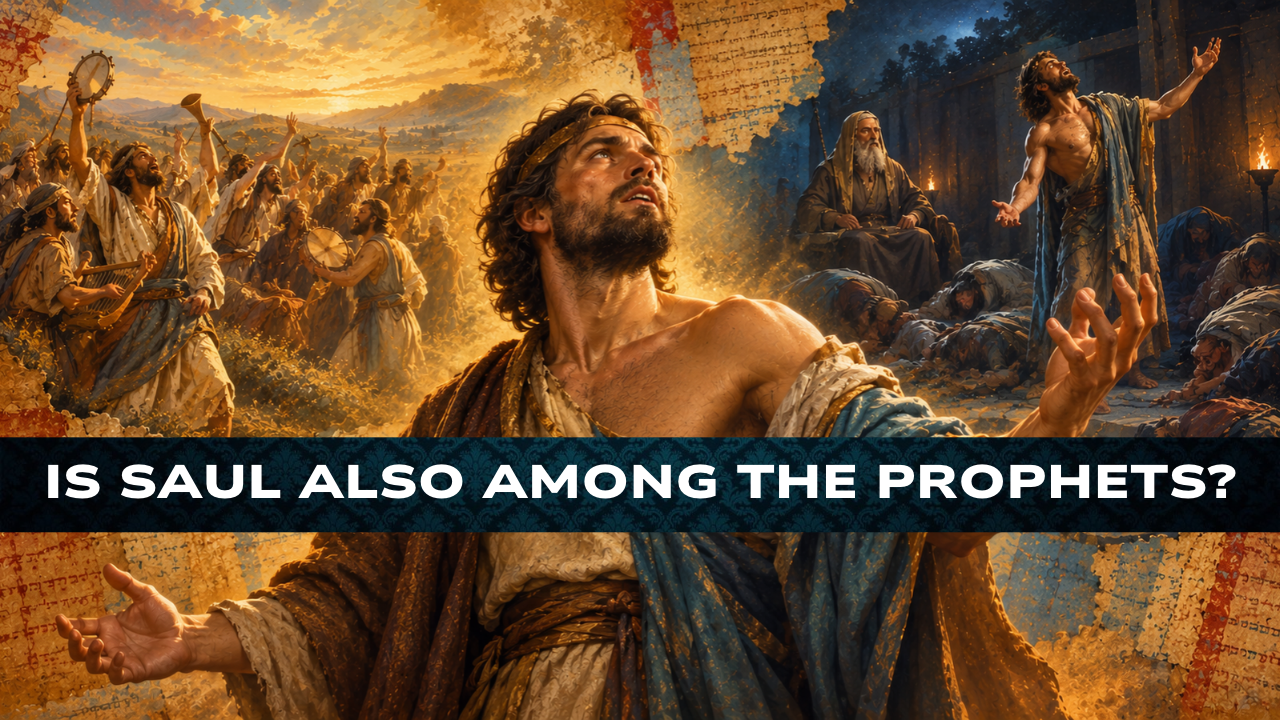
In 1 Samuel 10, Saul has just been anointed. The spirit of God rushes on him, he falls in with a band of prophets, and the locals who knew him as Kish’s regular guy do a double-take: “What has happened to the son of Kish? Is Saul also among the prophets?” A random bystander chimes in with “And who is their father?” and boom, proverb locked in. NASB keeps it short and clean: “Therefore it became a proverb: ‘Is Saul also among the prophets?’”
Fast-forward to chapter 19. David is on the run. Saul sends messengers to grab him; the messengers start prophesying. Saul goes himself; the spirit hits him too. He strips down, prophesies all day and night in front of Samuel, and the text helpfully informs us: “Therefore they say, ‘Is Saul also among the prophets?’”
Same saying. Two completely different origin stories. Classic.
This is not an isolated incident. The books of Samuel are a masterclass in narrative redundancy. You get two versions of how David enters Saul’s service (the harp player versus the giant-slayer who somehow needs an introduction later). Two versions of David sparing Saul’s life in the wilderness. Two versions of how David wasn’t really allied with the Philistines. Two accounts of Samuel’s death. Even Goliath gets killed twice, once by David, once by Elhanan in 2 Samuel 21, which is the kind of detail that makes harmonizers break out in hives.
These aren’t accidents. They’re the fingerprints of sources that got stitched together by editors who valued preservation over seamless storytelling. One layer gives you half the doublets; the other gives you the rest. You can practically watch the seams if you know where to look.
A note on my labels. I sort these layers partially by which divine name they use (Elohim or Yahweh) because that’s a criterion I can actually apply consistently and show my work on. I borrow “Elohist” and “Yahwist” from Pentateuchal scholarship, which is an unconventional move in Samuel, and I’m aware a fair amount of what I’m tagging is probably Deuteronomistic. But I’d rather name what I’m measuring than reach for a label I don’t feel comfortable with yet. When I know that source well enough to defend the call, I’ll make it. (I’ve got my source attributions mapped out over here if you want the full color-coded chaos)
Chapter 19 is especially fun because it contains a redundancy inside the redundancy. Verse 23 already has the spirit of God coming upon Saul so that he prophesies on the way to Naioth. Then verse 24 has him stripping off his clothes and prophesying all over again in Samuel’s presence. The text basically tells you twice that Saul started prophesying. That’s not elegant storytelling. That’s two hands on the keyboard…er, on the scroll.
So if the biblical etymologies are fabricated (and the double origin stories are a pretty strong clue that they are) what was the original saying actually doing out in the wild? Why would anyone have been saying “Is Saul also among the prophets?” in the first place?
Look back at the early Saul stories. Before the formal prophetic bands and the spirit-rushing and the public spectacle, Saul has already done something quietly prophetic. When he goes looking for his father’s lost donkeys, the narrative has him voice a concern, and Saul “predicts” that his father will stop worrying about the donkeys and start worrying about him instead if they don’t return. The text attributes the full prophetic framing to Samuel, of course. In 10:2 Samuel predicts that strangers at Rachel’s tomb will tell Saul the donkeys are found and “your father has stopped worrying about the donkeys and is anxious about you”, nearly Saul’s own words, handed back to him as news.
That’s convenient. It keeps Saul’s own predictive moment from counting as actual prophecy. But the raw material is right there: Saul anticipates what his father is thinking. That’s the kind of sharp insight that, in a world where prophets were the people who just knew things, could easily get you labeled “among the prophets.”
It’s not much. But it’s the closest the text comes to giving us a non-spectacular, non-ecstasy-based reason for the saying. Saul was among the prophets because he was a prophet…perhaps.
And here’s where the politics get interesting. Pro-David authors had every reason to reframe that association. If the original saying simply noted that Saul hung out with (or functioned like) prophets, it granted him a kind of legitimacy that the later tradition preferred to reserve for Samuel and, eventually, for David’s circle.
Hebrew builds meaning into verb patterns, and the root behind “prophesy” takes two forms in Samuel. One means receiving a message and delivering it e.g. what Nathan does when he confronts David. The other means behaving like a prophet: the trance, the fit, the loss of control.
The root appears twelve times in 1 Samuel, and ten are the ecstatic form. Saul is described with it six times out of seven: seized at Gibeah, raving in his house with a spear in his hand, stripped and lying on the ground a full day and night. And whichever form the text uses, it never once puts an oracle in his mouth. Saul has the symptoms of prophecy and none of the substance. The Biblical authors move Saul away from being a prophet while still being shackled by the saying.
Turning the saying into a question of astonished disbelief, (Is Saul also among the prophets?”) and then inventing two separate stories in which the spirit of God overpowers him against his will does neat ideological work. It makes Saul’s prophetic moments temporary, involuntary, and slightly embarrassing (the naked all-night session in chapter 19 is not exactly flattering). It keeps the real prophetic authority safely on the other side of the ledger.
This is the Bible doing what the Bible does best: preserving the seams, the doublets, the slightly awkward explanations that don’t quite line up. The editors didn’t smooth everything out. They left the two origin stories sitting right next to each other like rival cousins at a family reunion who both claim to have invented the family joke. And in the process, they accidentally handed us a window into how sayings travel, how sources get combined, and how later political needs reshape earlier memories.
Was Saul among the prophets? In the underlying tradition, maybe the answer was simply yes.