
The Defection of David & Jonathan
/
Here’s a theory that keeps getting sharper the more pieces you put next to each other.
The Climb That Wasn’t a Raid
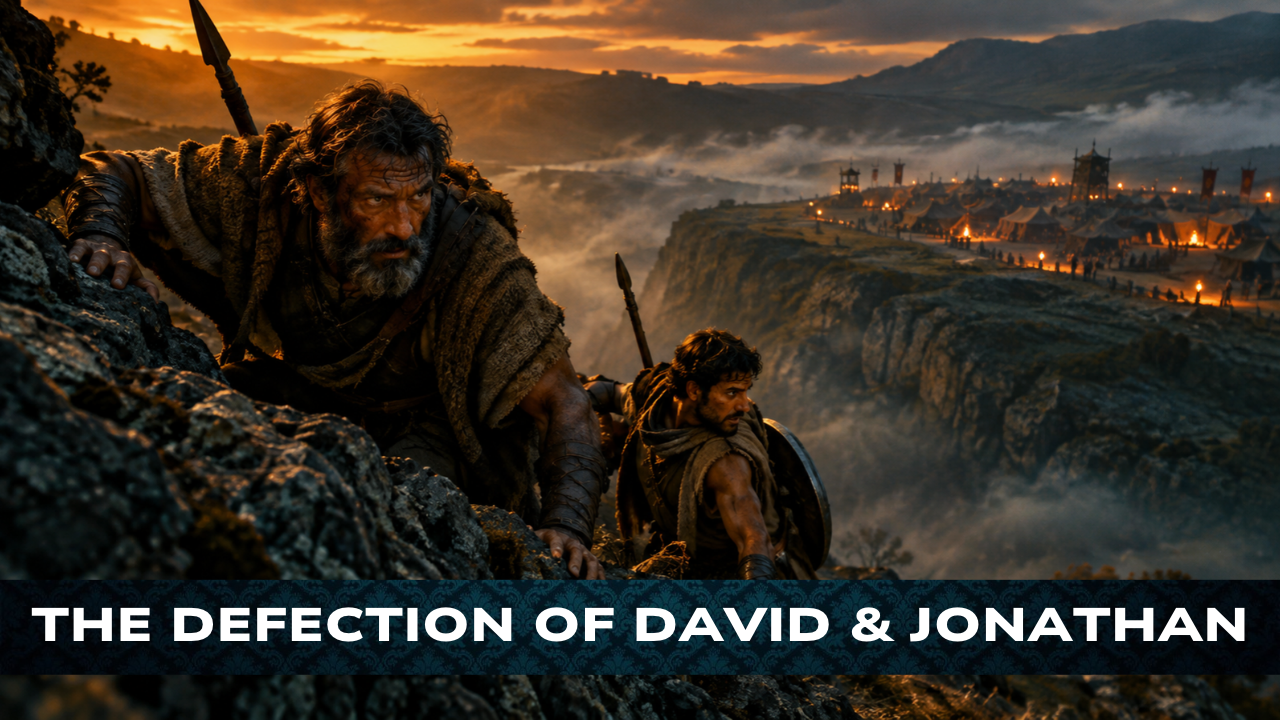
Jonathan and his anonymous armor-bearer do not scramble up that cliff in 1 Samuel 14 to fight the Philistines. They climb up to join them. The whole “heroic raid” is a cover for defection. And the armor-bearer is David.
Yes, that David. And Jonathan is not merely his friend. Jonathan is his son.
Father and Son, Not Just Friends
In a previous video I laid out the case that David had a secret affair with Saul’s wife. That is the real origin of the relationship the text later dresses up as pure, selfless friendship. The covenant, the giving of Jonathan’s gear (there’s that armor-bearer thing again), the weeping, the protection from Saul, none of it is just emotional bonding between two pure-hearted Israelites. It is a father and son aligning against the man who thinks he is the boy’s father. Once you see the blood connection, the team-up makes perfect sense, and the defection makes even more.
The text in chapter 14 is careful. Jonathan proposes the raid in secret. He does not tell Saul. The armor-bearer agrees instantly. They cross over, show themselves, and the Philistines invite them up. In the story the invitation is mocked as arrogance. In a defection reading it is recognition. Two high-value figures appear at the outpost and are waved in. They vanish. Saul takes a head count and they are “nowhere to be found.” Then we are told in 1 Samuel 14:21, “Now the Hebrews who were with the Philistines previously, who went up with them all around in the camp, even they also returned to be with the Israelites who were with Saul and Jonathan.” The storyteller is telling us, almost in the same breath, that people were switching sides and that two key men had disappeared. When pieced together, the vanishing and the switching are the same event.
The Nameless Armor-Bearer Trick
The armor-bearer never gets a name in that chapter. That is not an accident. We read about an anonymous armor-bearer later in the story as well. When Saul dies on Mount Gilboa there is again an armor-bearer who refuses to finish the job. Then Saul falls on his own sword because the armor-bearer definitely didn’t kill him (wink, wink). Same title, same narrative function: the figure who should be David is carefully left unnamed so the reader does not connect the dots too quickly.
David’s Philistine Career and the Cover Stories
David has a long, documented relationship with the Philistines. He lives among them. He serves Achish of Gath. He marches out with the Philistine army against Israel. One source claims he pretended to be insane and was no use to Achish. Another claims he spent his time raiding non-Israelite towns while telling Achish he was hitting Israelite ones. Two different damage-control strategies for the same embarrassing fact: David fought on the Philistine side.
Baden on Where David Really Was
Joel Baden, in The Historical David, walks through the cover-up in 1 Samuel 29–30 with characteristic clarity. David is Achish’s bodyguard. He should have been in the thick of the battle at Gilboa. The Bible will have none of this. Other Philistine officers suddenly object to “those Hebrews,” Achish is forced to send David home, and David protests that he wants to fight. The back-and-forth is designed to tell the reader that even if David had wanted to enter the battle against Saul, he was forcibly forbidden. Then comes the equally improbable Amalekite raid on Ziklag: not a single person harmed, not a single animal missing, and a conveniently abandoned Egyptian slave who just happens to know the way. Baden’s conclusion is blunt. Where was David while the Philistines were killing Saul and his sons? By all rights he should have been right there with them. And despite, or perhaps precisely because of, the Bible’s emphatic statements to the contrary, we may conclude that this is exactly where he was.
That lands differently once Jonathan is David’s son. The deaths of Saul and Jonathan on the same day are no longer simply a battlefield tragedy. They are the removal of the official father and the survival of the biological one. David ends up with Saul’s crown and armlet almost immediately. The bizarre Amalekite messenger story in 2 Samuel 1 exists to explain that awkward fact without letting David’s hands get dirty. Two conflicting accounts of Saul’s death: suicide after the armor-bearer refuses, or the Amalekite finishing the job. Both serve the same purpose: keep David clean. Baden notes that simply being on the battlefield does not prove David pulled the trigger, but one need not pull the trigger to be responsible (but I think he did though). The Philistines wanted Saul dead. David had every reason to want the same. And the man who walked away with the royal insignia is the man who benefited most.
The Ark as Treaty Token
Now fold the earlier defection back in. If David is Jonathan’s father, the climb in chapter 14 is not two friends on a suicide mission. It is a father and son cutting a deal with the stronger power on the coastal plain. The ark fits the same pattern. I previously argued that the ark began as a treaty object with the Philistines. The ark is connected to David even in the earliest layers of the text. The more I examine the Davidic material, the more the ark looks like a treaty specifically between David and the Philistines. An object that seals the arrangement between the rising warlord, his son, and their Philistine patrons would later need heavy rebranding. The partners get erased. The diplomatic function gets spiritualized. What remains is a sacred chest of pure Israelite memory.
Following the Tracks
The cover-up is not subtle once you are looking for it. Two separate traditions try to explain why David was with the Philistines and still somehow not a traitor. The armor-bearer trick keeps David’s name out of the scenes where his presence would be politically radioactive. The Ziklag interlude keeps him off the battlefield where Saul dies. The Amalekite messenger explains how the crown ended up in David’s hands without admitting he was there to take it. And the idealized “friendship” with Jonathan papers over the biological and political reality that the two of them were family, aligned against Saul from the start.
None of this requires inventing new events. It only requires reading the seams that are already there. People disappear. Defectors switch sides. Armor-bearers stay anonymous at convenient moments. David’s Philistine service is explained twice, in two incompatible ways. An ark still smells of diplomacy. A crown and armlet appear in David’s possession with only the flimsiest of explanations. And the one relationship the text works hardest to portray as pure friendship is the one that makes the most sense as blood and shared interest.
The text never says “David was Jonathan’s father and they defected together.” Of course it doesn’t. Successful cover-ups rarely announce themselves. What the text does is leave the tracks. Follow them and the traditional story of two pure-hearted friends against the pagan foe starts looking like the later polish on a much more complicated, and much more human, power play.