
Was Mephibosheth Impotent?
/
We’re about to talk about a guy whose name means something like “from the mouth of shame” (or whatever the later scribes decided it meant after they scrubbed the Baal out of it), who gets wheeled into the narrative of David’s court as the last sad remnant of Saul’s house, and the text keeps reminding us he is “disabled in his two feet” or “lame in both feet.” And then someone like me comes along and says, “Maybe the feet aren’t literal.” Cue the pearl-clutching.
But hear me out. We’ve already been down this road. Feet as a euphemism for genitals shows up enough times in the Hebrew Bible that it’s not some fringe conspiracy theory cooked up by bored graduate students. The “hair of the feet” in Isaiah. Spreading one’s feet in Ezekiel. Covering one’s feet when you need a private moment. I’ve written posts on Ruth uncovering Boaz’s “feet” and Sisera falling between Jael’s “feet.” The list goes on. Once you’ve seen it, you can’t unsee it.
So when 2 Samuel tells us, more than once, that Mephibosheth (or Merib-baal, as Chronicles calls him) was disabled in both feet, a certain kind of reader starts wondering. If “feet” can stand in for the goods downstairs, then “disabled in both feet” starts sounding a lot like “functionally out of commission in the reproductive department.” Impotent. Sterile. No heirs. End of the line.
And that would be convenient, wouldn’t it?
Because Mephibosheth is not just some random disabled guy David takes pity on for Jonathan’s sake. He is the surviving male of Saul’s house. He is a living, breathing alternative claim to the throne. Even if the narrative insists he is Jonathan’s son, the political reality is the same: he is Saulide royalty. A competing kingly line. (Whether he is actually Jonathan’s or David’s is a different blog post for a different day. Spoiler: the family trees get messy when you start looking closely.)
The author of the David story has every incentive to neutralize that claim. You don’t have to assassinate the last Saulide if you can just render him incapable of producing more Saulides. Disability in the feet (read as sexual dysfunction) does the job cleanly. No offspring means no future claimants. The Davidic line is safe. Problem solved. The text doesn’t need to moralize about it or explain divine judgment. It just states the fact, repeatedly, like a quiet little insurance policy.
But wait, you say. Doesn’t the Bible give us a perfectly good backstory? 2 Samuel 4:4: “he was five years old when the news came from Jezreel about Saul and Jonathan. His nurse scooped him up and fled, and in her haste she dropped him, and he became lame.” Case closed. Literal accident. Literal feet. Move along.
Except… is that backstory original?
It feels suspiciously like a later addition. The detail is completely unnecessary for the narrative that follows. When David asks if anyone is left of Saul’s house, Ziba can just say, “There is still a son of Jonathan who is crippled in both feet” (2 Samuel 9:3, NASB), and the story proceeds. We don’t need the childhood trauma dump. It doesn’t advance the plot. It doesn’t deepen character. It just sits there, explaining away the disability.
And then, right in the middle of David’s kindness scene, we get this: “Mephibosheth had a young son whose name was Mica” (2 Samuel 9:12, NASB). A son. Named Mica (or Micah, depending on the list). Suddenly the guy who was supposed to be the end of the line has an heir. The competing claim is back on the table, at least potentially.
But why would a text do that? My best guess is that someone later in the transmission process looked at the original portrait of a childless, disabled Mephibosheth, politically neutered, narratively convenient, and had a problem on their hands. By that point, Mephibosheth’s descendants had become too large and too well known to ignore. You can’t just write a prominent, still-existing family out of the story by declaring their ancestor sterile when everyone knows the family is still around and thriving. So the redactor does the only sensible thing: make the feet literal (a childhood accident, nothing more) and give the man a son. Now the disability is just a disability, the family line continues, and the earlier political erasure is quietly walked back.
The backstory is superfluous. It serves no real purpose except to explain something that, in the original telling, may not have needed explaining because it wasn’t about literal feet.
Compare Asa. 1 Kings 15:23 (NASB): “But in the time of his old age he was diseased in his feet.” That’s it. No childhood nurse. No dropped toddler. No dramatic flight from Jezreel. Just an old king whose feet had an issue. Associated with old age. No etiology required. The text is perfectly content to let “diseased in his feet” stand on its own, probably with the same euphemistic meaning in view.
If the Mephibosheth notice originally worked the same way, a simple statement of disability, no backstory, it would not have been weird. Biblical narrators do not feel obligated to give us medical histories for every physical condition they mention. When they do supply one, it’s often because a later hand decided the original was incomplete or politically awkward in light of later realities.
So was Mephibosheth impotent? In the earliest version of the story, quite possibly yes, or at least the author wanted readers to understand him that way. Not because the historical figure couldn’t father children, but because his descendants needed to be taken off the board. Disability in both “feet” did the job. The accident story and the sudden appearance of Mica look like later damage control: make the feet literal, acknowledge the son, and bring the text into line with a family that had grown too big and too visible to keep pretending didn’t exist.
The Bible is full of these little seams. A detail that seems explanatory until you notice it explains something that didn’t need explaining. A son who appears just in time to match the real-world situation the narrative had earlier tried to erase. A euphemism that a later redactor prefered to take at face value once the political convenience has expired.
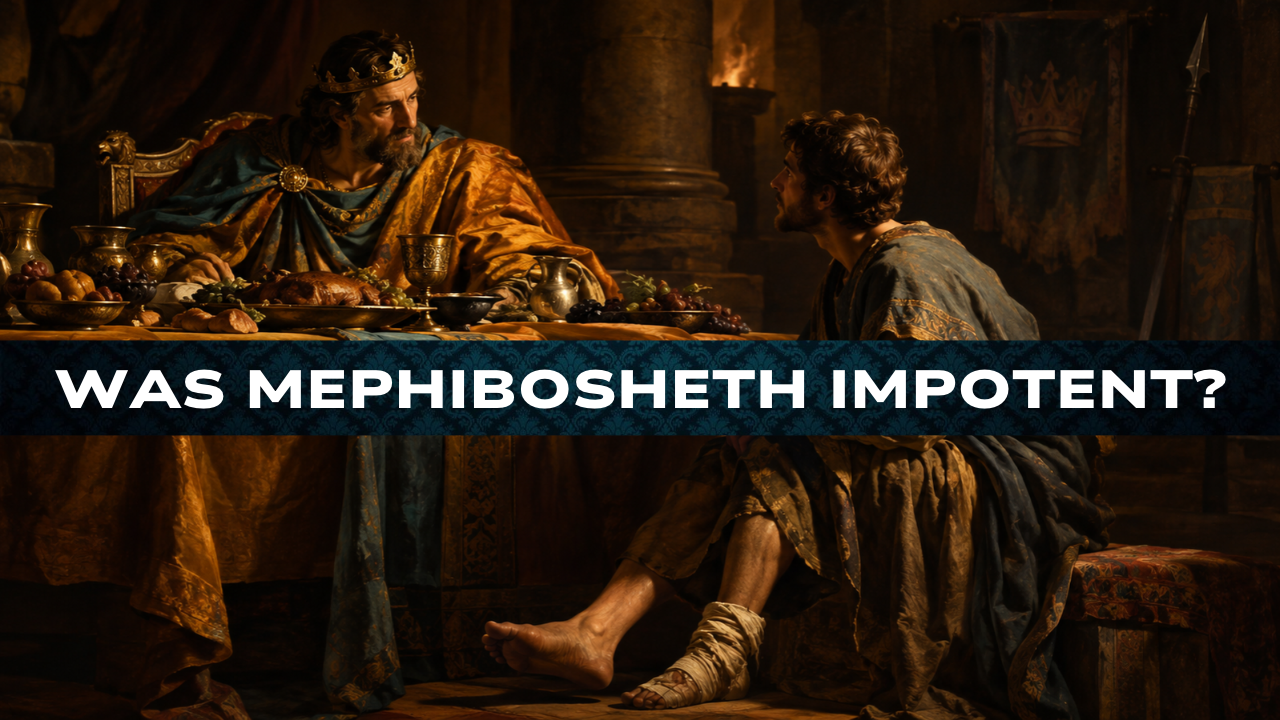
Mephibosheth sits at David’s table, eating the king’s bread, the last Saulide in plain sight and yet somehow no threat at all. The text wants you to see the kindness. It may also want you to see the containment. And if the feet were never just feet, then the containment was more thorough than the later redactors were entirely comfortable admitting once the descendants became impossible to ignore.
That’s the fun of this stuff. The surface story is about loyalty and grace. The compositional history is about succession, sterility, and the quiet ways authors and editors manage claims to power… until the claims become too loud to manage. Both can be true. The Bible is allowed to be that interesting.