
The Abrupt End of Peter: Did Acts Hide His Execution?
/
Many readers will be familiar with the story, even if they don't know where it comes from. It is practically a baseline assumption of church history: Peter went to Rome, faced the wrath of Emperor Nero, and out of sheer humility, requested to be crucified upside down because he wasn't worthy to die like Jesus.
It is a dramatic, visually striking, and deeply pious narrative. But when you start pulling at the historical and textual threads, the grand tapestry of Peter’s traditional martyrdom begins to unravel. What if the earliest sources we have don’t point to Rome or a humble upside-down crucifixion at all, but to a messy, political execution that the Bible itself tried to scrub, literalize, and abruptly bury?
The Gnostic Roots of the "Upside-Down" Tradition
The biggest problem with the upside-down crucifixion story is its timing and its source. It doesn’t appear anywhere in the New Testament. Instead, it makes its debut in the late second-century apocryphal text known as the Acts of Peter.
As scholars like Dr. Candida Moss have pointed out, this text is heavily steeped in early Gnostic-leaning ideas. In the Acts of Peter, his upside-down execution isn't a mere gesture of standard humility; it is a highly theological, cosmic metaphor. The text argues that humanity has been turned upside down by sin, viewing things inverted from reality. Peter hangs upside down to symbolize seeing the world as it truly is from a spiritual perspective.
Later, orthodox church writers stripped away the complex, Gnostic framework and repurposed the imagery into a simpler story of moral humility. The tradition isn't historically reliable, it’s an adapted theological fable.
The Literalization of a Metaphor in Acts 12
If the upside-down Roman narrative is a later invention, where can we look for clues about what actually happened to Peter? The answer might be hidden right in the book of Acts, masquerading as a miraculous prison break.
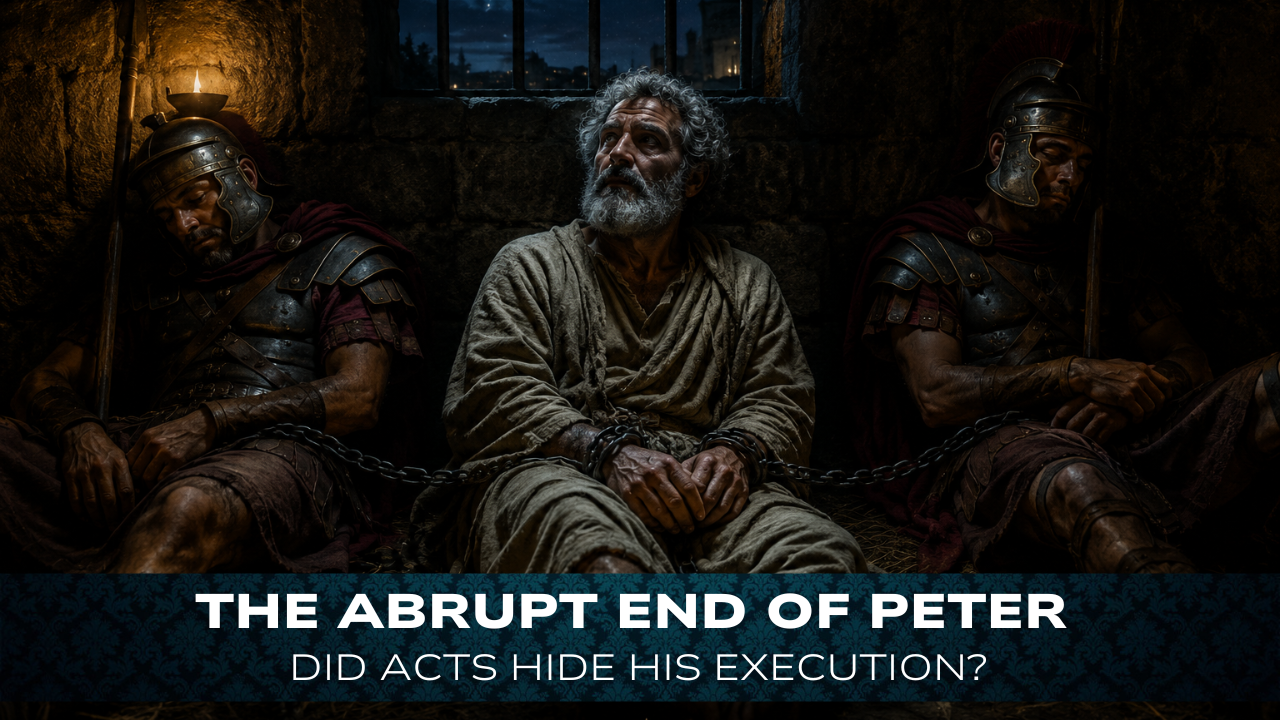
In Acts 12, King Herod Agrippa begins a localized crackdown on the Jerusalem church, executing James the brother of John. He then arrests Peter. The narrative tells us that Peter was bound with chains and "sleeping between two soldiers" the night before his intended execution, only for an angel to wake him up, strike off his chains, and break him out.
But look closer at the phrasing. In the ancient world, "falling asleep" was one of the most common, universal euphemisms for death. What if the author of Luke-Acts did what biblical authors frequently do: took a known historical reality (Peter dying between two soldiers) and converted a metaphorical euphemism ("he fell asleep") into a literal, miraculous story? I’ve written previously how Biblical writers would turn the metaphors into literal events such as the “feet” and “bread” as well as a video series on the Metaphorical framework of Jesus, the Sea of Galilee and the Resurrection Motif.
There is a subtle clue in the text regarding Peter’s clothing here, too. The angel tells Peter to wrap his cloak around himself and gird (zōnnymi) his own belt. Keep that specific detail in mind, because it stands in stark contrast to how his story ends elsewhere.
The Abrupt Disappearance
Right after this bizarre "escape" sequence, the text says Peter went to the house of Mary, knocked on the door, startled a servant girl named Rhoda, and then simply “departed and went to another place” (Acts 12:17).
After this point, Peter virtually vanishes from the Book of Acts. He is mentioned just once more briefly in chapter 15 during the Jerusalem Council, but I suspect that it’s a later addition. For all intents and purposes, Peter’s narrative life ends right there in chapter 12.
This mirrors the treatment of Paul at the end of Acts. Paul’s story stops dead in its tracks while he is under house arrest in Rome. In a previous video, I proposed that the author stopped writing because there was simply no more life left to report. Paul may have died in the shipwreck detailed in Acts 27, and the author wrapped up the narrative abruptly rather than focusing on an unheroic or problematic death.
If Peter didn't escape Herod, his narrative ended in Acts 12 for the exact same reason: he was dead.
Decoding the Propaganda in John 21
If Peter truly died in custody under Herod Agrippa, how exactly did it happen? The Gospel of John breaks the silence, dropping the metaphorical veil to give us a direct window into his execution:
"Very truly I tell you, when you were younger you dressed yourself and went where you wanted; but when you are old you will stretch out your hands, and someone else will dress you and lead you where you do not want to go.” Jesus said this to indicate the kind of death by which Peter would glorify God. (John 21:18-19)
The phrase "stretch out your hands" was a widely recognized ancient idiom for crucifixion. John is openly admitting that Peter was crucified.
Notice the deliberate inversion of the language from Acts. In Acts, Peter binds and dresses himself to escape. In John, the reality is restored: someone else binds him and stretches out his hands.
The True Propaganda: The spin here isn’t how Peter died. John wasn't inventing the crucifixion; Peter really was executed. The propaganda lies in the theological framing, the claim that he was crucified "to the glory of God."
Peter wasn’t crucified to glorify the Christian God. He was viewed as a dangerous, messianic insurrectionist threatening the local peace under Roman-backed rulers.
Peter didn't die an old man upside down in Rome out of pious humility. He was arrested in Judea, bound between two soldiers, and executed on a Roman cross as a political criminal, but that didn’t fit the agenda of Biblical authors, so they rewrote his final moments.