
The Secret Battle Over "Bread" in the New Testament
/
When we read the New Testament today, we tend to take its stories literally. We picture a basket of actual loaves feeding thousands, or Jesus physically breaking a piece of bread at the Last Supper. But if you dig beneath the literal surface, a fascinating, highly political theological battle comes to light.
I propose that, to the followers of Jesus (and possibly followers of other Messianic movements), "bread" was a common metaphor for a Messiah’s core message.
When we re-examine the Gospels and Epistles through this lens, a radical theory emerges: the stories about bread aren't just miracle accounts. They are sophisticated, editorially manipulated narratives designed to merge competing Messianic movements into a single, unified church.
Jesus’s Original "Bread": Rejection of the Elite
To understand how the metaphor was manipulated, we first have to look at what Jesus’s original "bread" actually was. His core message was a direct attack on the religious and social establishment. You can view my video on “What Jesus Really Said about the kingdom of God” to see how I reconstructed the original teaching of Jesus.
Before NT author’s changed his message, Jesus preached a radical reordering of society: God had rejected the elite and was instead welcoming the unclean, the outcasts, and the sinners into the Kingdom of God. This subversive message was the "bread" he offered.
Competing Messiahs and the Breadless Disciples
A major challenge for early the New Testament authors was that Jesus wasn't the only charismatic leader with a following. Historically, Peter and the Twelve may have had their own independent movements. They might never have closely known the historical Jesus, or if they did, they became independent Messianic figures with their own distinct doctrines after his death.
To absorb these competing factions into the central "Jesus movement," New Testament writers used brilliant literary framing. They frequently took abstract metaphors and turned them into literal, historical events, subtly altering their meanings along the way.
This explains why the disciples are portrayed as having no bread.
When Jesus sends them out on a journey, he commands them to "take no bread."
In Mark 8, the text explicitly notes that the disciples "had forgotten to bring bread."
By literally depicting the disciples as "breadless," the authors are making a sharp theological point: The Twelve did not possess their own independent message. Any "bread" they did have, they received directly from Jesus. We see this in the feeding of the 5,000, the feeding of the 4,000, the Last Supper, and the Road to Emmaus. In every instance, Jesus is the source, and the disciples are merely the recipients(and sometimes distributors) of the “bread”.
"Don’t Give Bread to Dogs"
Understanding bread as a message also unlocks one of the most troubling sayings attributed to Jesus. When a Canaanite woman begs him to heal her daughter, Jesus initially refuses, saying, "It is not right to take the children’s bread and toss it to the dogs."
In the raw, historical context of the movement, "dogs" was a common Jewish derogatory term for Gentiles. Jesus’s original message, his “bread”, was exclusively for the house of Israel. The kingdom was not meant for outsiders.
However, New Testament authors wanted to dilute the strictly Jewish messianic movements to include Gentiles, so they sanitized this exclusive statement. They took a harsh theological boundary and reframed it as a narrative test of faith. By changing the context from who gets the message to a demonstration of the woman’s persistence, they allowed Jesus to grant her a miracle while subtly shifting the definition of bread away from an exclusive Jewish doctrine.
The "One Loaf" Propaganda
This brings us to the Pauline Epistles (which I believe were not written by Paul and were propaganda). In 1 Corinthians, the text emphasizes that "because there is one bread, we who are many are one body, for we all partake of the one bread."
Why the intense fixation on "one bread"? Because New Testament writers desperately wanted to prevent readers from realizing that different Messiahs were preaching different messages.
This perfectly mirrors the gospel narrative where the disciples forgot bread. The text in Mark 8:14 drops a highly specific detail: "they had only one loaf with them in the boat." That "one loaf" isn't a random grocery tally; it is a theological enforcement mechanism. The New Testament authors were insisting that there is only one valid doctrine, and it belongs entirely to the centralized Jesus movement.
Judas and the Morsel of Bread (psōmion)
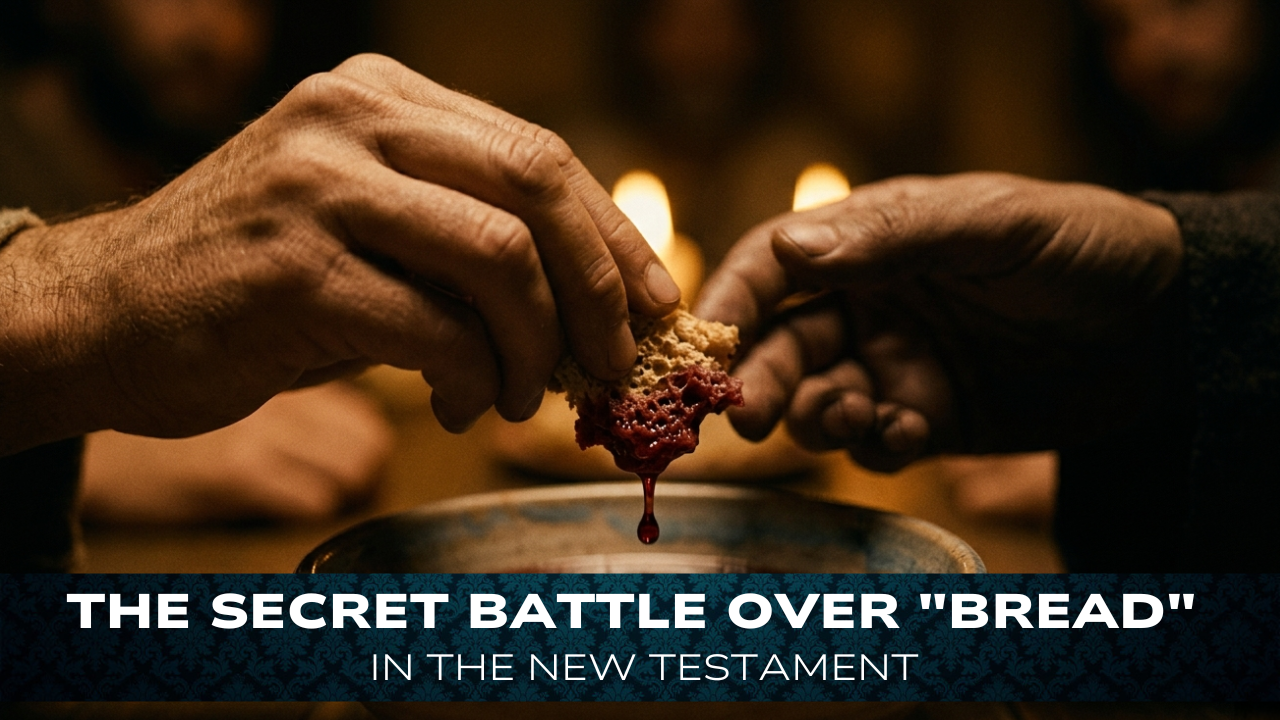
One of the most cryptic uses of the bread metaphor occurs during the Last Supper in the Gospel of John, when Jesus identifies his betrayer by handing him a morsel of bread.
"Jesus answered, 'It is the one to whom I will give this piece of bread when I have dipped it.' Then, dipping the piece of bread, he gave it to Judas Iscariot."
In the original Greek, the word used here is psōmion (ψωμίον), which refers to a tiny crumb or a diminished morsel.
This implies that Judas received an additional message (bread) from Jesus, but it was fundamentally altered and minimized by the act of "dipping" it. This psōmion represents a highly specific, different message tailored only for Judas. The tragic directive that would seal Jesus's fate: "What you are about to do, do quickly." Judas's morsel was a small, specialized script that led directly to the crucifixion.
From the Message to the Messenger
The ultimate sleight-of-hand pulled off by the New Testament writers was moving completely away from bread being a metaphor for a message and instead making Jesus himself the bread.
In the Gospel of John, Jesus declares, "I am the bread of life." By transforming the metaphor from a Messianic message into a divine person to be worshipped, the authors effectively neutralized the competing Messianic messages of the era. You no longer had to debate whose teachings were correct; you simply had to accept the singular, universal Bread of Heaven.