
Why Did Jesus Wash Peter’s Feet? A New Theory About the Original Meaning
/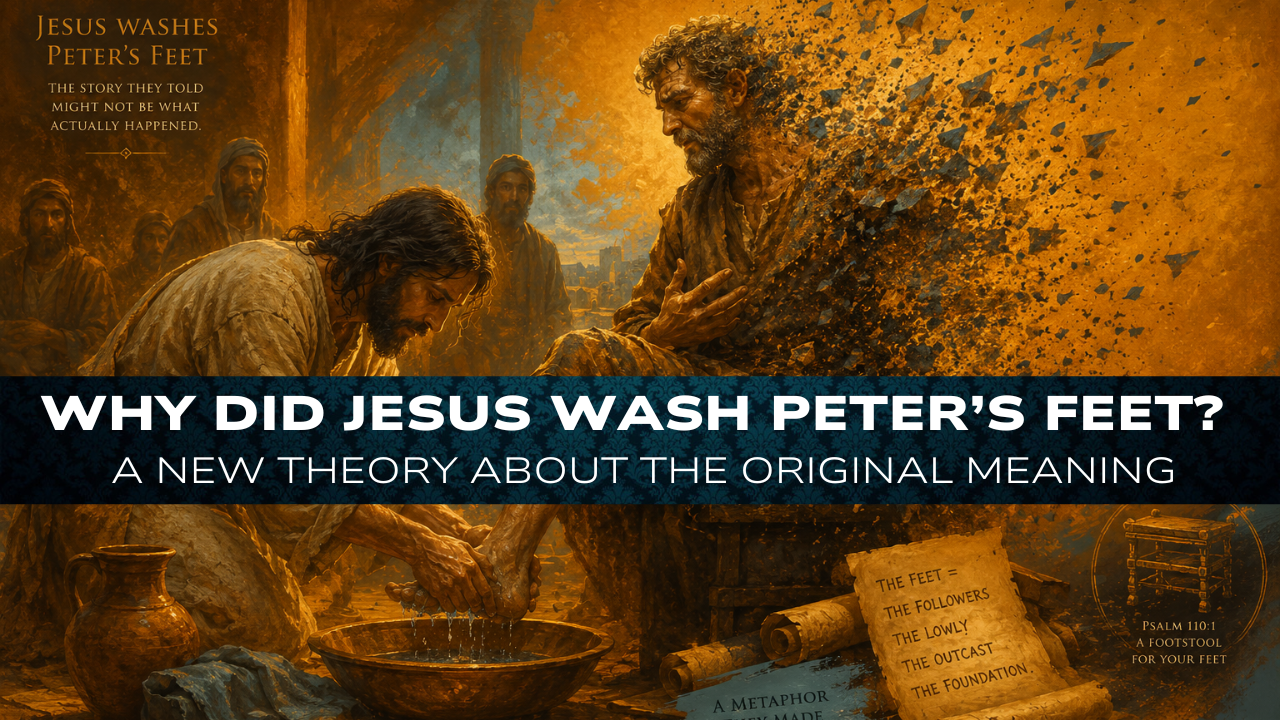
In my previous post, I wrote about how Peter was a rival Messiah of Jesus, and one of the passages that didn't make sense to me was the one about Jesus washing Peter's feet. I knew that since Jesus and Peter never knew each other, this event couldn't have happened. So what was the point of it? I did a quick search for "feet" in the gospels and found that it showed up more often than I expected.
I had done previous videos on how the Biblical authors had taken metaphors about Jesus and had made them literal events, so I wondered if the same was happening with "feet". Some have proposed that there is something sexual going on in this scene with Jesus and Peter since "feet" was used as a euphemism for genitals during that time. I have talked about it as a sexual euphemism before (see my video on Ruth and post on Jael), but I don't think that's the case here. It just doesn’t fit the scene nor the repeated use of feet in the NT. Let me explain.
The Seed of the Metaphor: The Old Testament "Footstool"
To understand what "feet" originally meant to the earliest Jesus movement, we have to look at the scriptural bedrock it was built on. They didn't just pull this imagery out of thin air; they likely based it on specific Old Testament passages:
Psalm 110:1: "The Lord says to my Lord: 'Sit at my right hand until I make your enemies a footstool for your feet.'"
Psalm 8:6: "You made him ruler over the works of your hands; you put everything under his feet."
In these original contexts, the imagery is about total domination and subjection. To place enemies "under someone's feet" or make them a "footstool" was an ancient way of describing conquered peoples being brought under the authority of a ruler. Psalm 8:6 originally referred to humanity and Psalm 110:1 is more complex but you can read my post on Melchizedek to understand who that originally referred to. But Jesus (and possibly other derivatives of John the Baptist) would give “feet” a new meaning.
The Core Shift: Who Are Jesus's "Feet"?
As I explained in a previous video, when John the Baptist died, a massive theological shift occurred. Jesus declared that God had rejected the rich, the powerful, and the religious elite of Israel. They were no longer the priority in the Kingdom of God. Instead, God chose the poor, the unclean, and the sinners.
Originally, in the earliest oral traditions and metaphors, "feet" referred to these exact people: the poor, the outcast, the unclean followers of Jesus. The lower parts of the body became a metaphor for the lower parts of society.
But the Biblical authors took a vibrant, sociological metaphor and literalized it into physical flesh and bone.
Subverting the Rival Messiah: Jesus Washes Peter's "Feet"
Once you realize that "feet" originally referred to "followers," the bizarre story of Jesus washing Peter’s feet in the Gospel of John takes on a completely different, power shifting meaning.
If Peter was a rival messiah with his own following, the historical reality was a tug-of-war for authority. By changing the metaphor into a literal event, the author of John pulls off a brilliant double-move:
They literalize the event to make it a touching historical narrative in order to move away from a metaphorical understanding.
They completely subvert Peter's authority. As a metaphor, Jesus cleansing Peter's "feet" meant that Jesus was the one making Peter’s followers clean. It implies that Peter’s followers didn’t achieve purity or salvation from Peter, they needed Jesus to legitimize them. Peter was not the Messiah, Jesus was.
The Original Meaning Behind the Woman Washing Jesus’s Feet
This literalization also completely flips how we view the famous story of the woman washing Jesus's feet with her tears and hair.
Originally, this was a metaphor describing the tradition about a woman (or a group of women) who helped take care of the followers (the "feet") of Jesus. The mention of loose hair strongly hints at a prostitute in the ancient world, of which many of the women who followed Jesus likely were.
To sanitize this and elevate Jesus, the Biblical authors collapsed the metaphor: the prostitute is no longer ministering to a messy group of poor followers; she is simply a woman literally washing the physical feet of Jesus himself with her loose hair.
Tracing the "Feet" Metaphor Throughout the New Testament
Once you put on these "metaphorical glasses," verses across the rest of the New Testament start clicking into place. Later authors seem to actively struggle with, or try to move away from, this original definition.
The Gospel and Acts: Literalizing the Community
Matthew 10:14: "And whosoever shall not receive you, nor hear your words, when ye depart out of that house or city, shake off the dust of your feet."
The Metaphor: This may have originally meant that those in that house or city that had become followers of Jesus were made clean, but their "uncleanness" or judgment was being deposited directly onto the rejecting house or city.
Acts 16:24: "...thrust them into the inner prison, and made their feet fast in the stocks."
The Metaphor: Instead of just Paul and Silas's literal ankles being locked up, this could historical-metaphorically refer to the entire community of followers being suppressed and placed in stocks by authorities.
The Epistles: Reclaiming and Shifting the Meaning
The Pauline epistles and later writers seem keenly aware of the "feet = followers/low-status members" concept and try to redefine it.
1 Corinthians 12:20-21: The author of 1 Corinthians explicitly writes, "But now there are many parts, but one body. And the eye cannot say to the hand, “I have no need of you”; or again, the head to the feet, “I have no need of you." This pushes back against the idea that any social strata had been rejected by God and joins together the “feet” with the rest of the “body”.
1 Timothy 5:10: When discussing requirements for widows, it mentions if she has "washed the saints' feet." This feels like a conscious effort to institutionalize the practice into a literal, pious ritual, further burying the radical, original metaphor of caring for the societal dregs.
Revelation 1:15: "And his feet like unto fine brass, as if they burned in a furnace..." If the "head" of the son of man is glorified in heaven, his "feet" (his followers) are currently going through the fiery furnace of persecution. Here, it seems to retain the original metaphorical meaning but shrouds it in apocalyptic language.
Conclusion
The transformation of "feet" from a radical sociological metaphor for the unclean, poor outcasts of the Jesus movement into a series of literal, physical interactions is a masterclass in how Biblical authors changed the narrative to fit their agenda. By reading between the lines and looking past the physical narrative, we catch a glimpse of the real history: a messy, gritty movement of the lower classes that later writers desperately tried to clean up, smooth over, and literalize.