
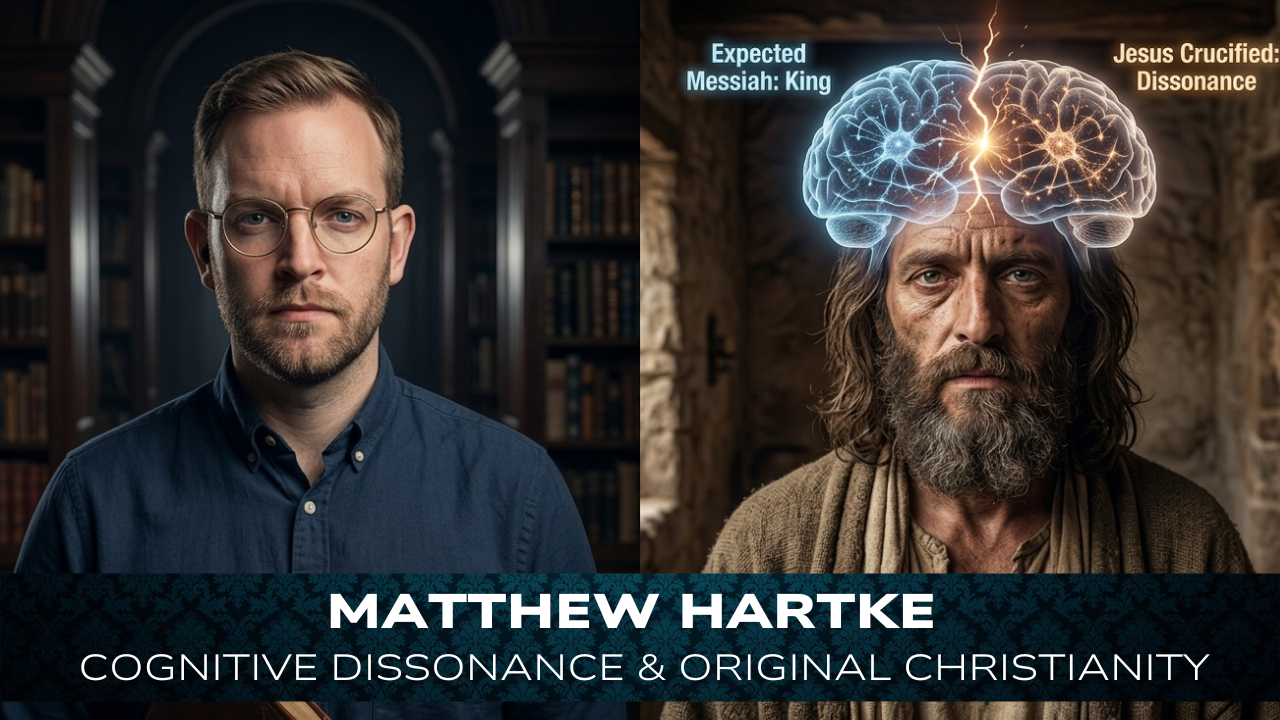
Matthew Hartke, Cognitive Dissonance & Original Christianity
/
If you have spent any time in the online biblical studies or critical analysis communities, you are likely familiar with the work of Matthew Hartke. Through his blog Resurrection Review and various digital platforms, Hartke has been a vital voice for rigorous, evidence-based inquiry into early Christian origins.
I recently saw his public post on X sharing that he's facing a financial hurdle due to unexpected medical debt from a recent surgery. Seeing that immediately made me want to write this post. It gives me a perfect opportunity to promote his practical need, while also giving me a chance to revisit his landmark research through the lens of my own ongoing historical-critical analysis
Matt’s landmark work frequently utilizes Cognitive Dissonance Theory (CDT) to argue that the earliest disciples experienced a profound psychological mismatch when Jesus was crucified, subsequently resolving that tension by "spiritualizing" the apocalyptic expectation of the Kingdom.
While I have immense respect for that framework, my own analysis has led me to make a slight shift in how we apply cognitive dissonance to early Christian origins. By looking deeper into the text, I've identified four major variations where my reconstruction departs from Hartke's thesis.
1. There Was an Entirely Different "First Solution" to the Dissonance
Hartke argues that the immediate response to the crucifixion was the birth of early orthodox Christology, spiritualizing the kingdom to resolve the shock of Jesus' death. My research indicates there was a completely different, earlier solution that has been hidden beneath the layers of the New Testament text.
When Jesus died, the original church didn't immediately turn him into a cosmic, spiritual savior who fulfilled all things. Instead, to resolve their dissonance, they birthed a radical, comforting survival theology I call "The Two Ways." They concluded that Jesus had died, descended to Hades, and become Christ in the spirit, ruling strictly as Lord of the dead. But because a dead spirit cannot physically overthrow Rome, they maintained that a separate, physical Christ in the flesh was still expected to come and establish the literal Kingdom on earth. See my video about the reconstruction of the situation in Thessalonica for details.
Later, New Testament authors would provide the solution to the cognitive dissonance that we are familiar with as Christianity today.
2. The Original Church Rigidly Maintained the Expectation of a Physical Kingdom
A core pillar of Hartke's view is that early Christians quickly abandoned the expectation of an immediate, physical, earthly kingdom in favor of a deferred, spiritualized reality. However, my reconstruction indicates that a tangible, political kingdom on earth remained the non-negotiable core of the original church's theology.
Whether they interpreted specific Old Testament prophecies literally or metaphorically, the fundamental outcome they expected never changed: an actual, physical kingdom established right here on the ground. When Jesus died, they did not suddenly transform his message into a detached, heavenly salvation. Instead, they preserved their earthbound political expectations by splitting the messianic role into two distinct phases. They accepted that Jesus had become a spiritual Messiah in Hades to rule the dead, but they steadfastly expected a future Christ in the flesh who would arrive to achieve what a spirit could not: the concrete overthrow of oppression and the physical establishment of wealth, glory, and dominion on earth. It was only later that NT writers stepped in to retroactively redirect the "Day of the Lord" away from this physical expectation.
3. The New Testament Writers Literalized the Metaphors of Jesus' Followers
While Hartke views the physical resurrection narratives as legendary developments or visionary evolutions within the church, my analysis of the Gospels & Acts shows a deliberate propaganda technique: the authors took existing, figurative metaphors used by Jesus’ followers and turned them into literal historical events.
In the earliest layers of the movement, entering the Kingdom of God was described using a strict, symbolic Resurrection Motif (comprising elements like death/tombs, burial linens, nakedness or white robes, and the designation of converts as "young men"). We see this conversion metaphor in the stories of Lazarus, the raising of the widow's son ("Young man, arise"), and the Gerasene demoniac. Watch my video on the Resurrection Motif to learn more details.
The New Testament writers leveraged people's familiarity with this existing metaphorical structure and manipulated it, turning a symbolic ritual of conversion into the literal, physical resurrection of Jesus.
4. New Testament Authors Didn't Have Dissonance, They Exploited It
Finally, Hartke's model places the cognitive dissonance squarely in the minds of the writers and the community producing the texts. I argue the exact opposite: the New Testament writers themselves were completely free of cognitive dissonance.
Instead, these Roman-sponsored authors were master political communicators who took advantage of the massive cognitive dissonance tearing through the early convert communities. They provided a calculated, pacifying cognitive solution for others to swallow, effectively manipulating later generations into accepting a gentile friendly, non-violent theology disguised as the original faith. See my New Testament Grand Theory for more details.
Conclusion
By shifting the cognitive dissonance away from the authors and back to the original, suppressed theology of the first disciples, the New Testament ceases to look like a record of confused believers trying to find their way. Instead, it reveals itself as a highly sophisticated literature of containment and political pacification.
Independent research thrives when we challenge existing paradigms and support the creators who push the conversation forward. Right now, Matthew Hartke is facing a major hurdle with unexpected medical debt following a surgery. If his work has ever sharpened your critical understanding of these texts, please consider heading over to X or Bluesky and sending some financial support to his Venmo: @MatthewHartke.