
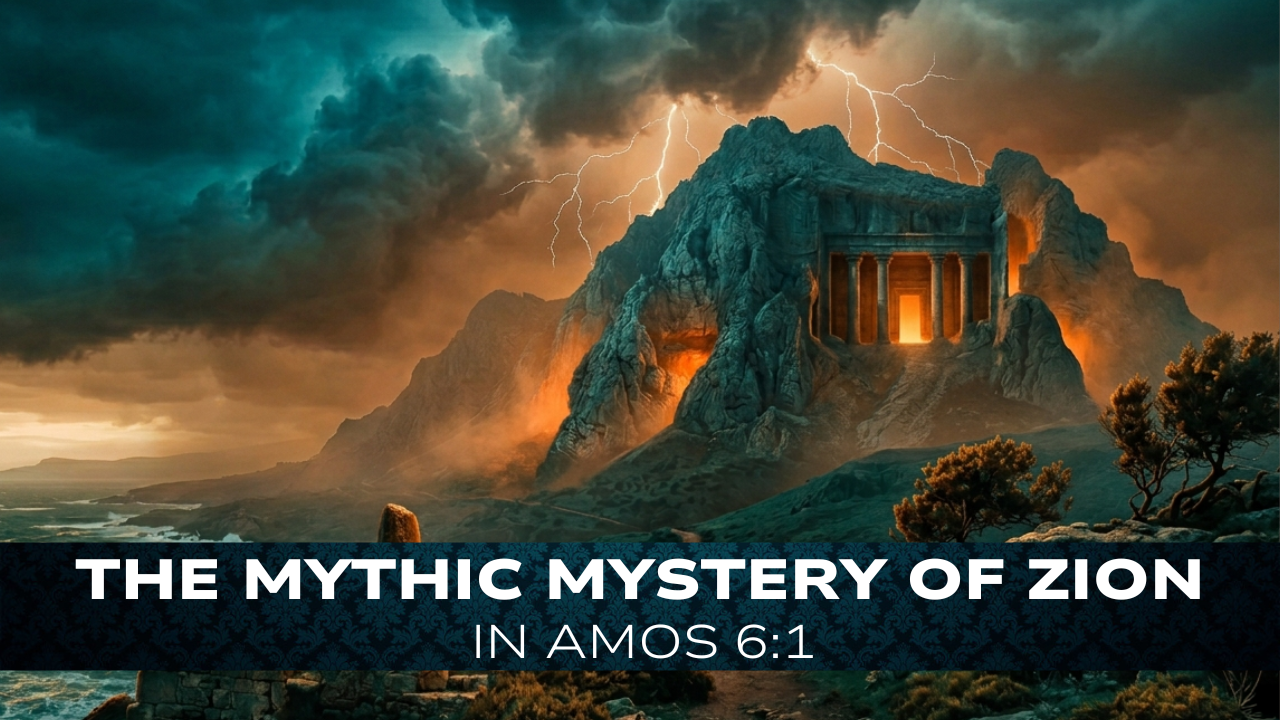
The Mythic Mystery of Zion in Amos 6:1
/
Have you ever stumbled across a verse that feels like a puzzle piece from the wrong box? Amos 6:1 is exactly that. Traditionally, Amos is the prophet of the North, delivering blistering critiques to the Northern Kingdom of Israel. Yet, the verse begins with a jarring reference to Zion, the heart of the Southern Kingdom’s capital, Jerusalem.
I used to view this text as a Jerusalem-centric prophecy that was later adapted for the Northern Kingdom. However, I’ve moved away from that interpretation in favor of a stronger alternative. Let’s take a look at the text:
Woe to those who are at ease in Zion
and for those who feel secure on Mount Samaria,
the notables of the first of the nations,
to whom the house of Israel resorts!
That 3rd line is weird too. Who are these “notables” that the Israelites were going to? Some translations say “dignitaries” or "chieftains".
It seems grammatically clunky in the Hebrew which has led many to conclude that the text is corrupted. W. L. Holladay mentions1 that a favorite emendation is:
and they are like gods in the house of Israel
But Hebrew poetry often uses dense, unusual phrasing, and Holladay himself doesn’t see it as corrupted and translates the last two lines as
“the pick of the first of the nations,
the cream of the crop of the house of Israel.”
Regardless, it doesn't solve the Zion issue. So what’s going on here?
Zion: The Mountain of the Gods?
To understand the verse, we have to look at it from the perspective that the Biblical authors wrote deceptive propaganda. They changed the narrative wherever they could to support their agenda. This includes changing the narrative about Zion.
As I’ve written before, I show how Biblical authors used parallelisms to achieve a changing of the narrative by equating two things that were not originally the same. In the case of Zion, it was equating it with Jerusalem.
To solve the Zion riddle, we have to look past Jerusalem. Evidence suggests that Zion wasn't always a street address in Judea; originally, it appears to have been a mythic mountain, a divine residence for the gods.
Think of it as the Canaanite version of Mount Olympus. This mythic Zion shares DNA with Mount Saphon from the Baal Cycle, where the god Baal took up his residence.
You can watch my video to see how this understanding of Zion formed the earliest layer of Psalm 48.
So I’m proposing that this instance of Zion in Amos refers to that original mythic narrative. With this in mind, I would paraphrase Amos 6:1 something like this:
Woe to those who are at ease on the Mountain of the gods
and for those who feel secure on Mount Samaria,
the gods of the nations,
to whom the house of Israel resorts!
In this light, Amos isn't confused about geography; he is attacking the wealthy elite and the gods they worshipped. It is a dual critique of Israelite arrogance and their devotion to deities other than Yahweh.
Propaganda and the Pivot
If true, this is a fascinating piece of text that harkens to the original Zion before the Biblical authors had a chance to equate it with Jerusalem. It would have been a tricky text for them to deal with. Propaganda can’t be too heavy-handed in trying to change the narrative, or else the authors tip their hand to the original readers who were already familiar with the story. But there does seem to be at least a couple of attempts in Amos to shift it away from the original Zion narrative.
In Amos 1:2, it uses the typical parallelism to try to change the narrative:
Yahweh roars from Zion,
And from Jerusalem He utters His voice;
This layer was most likely added after the southern exile to "muddy the waters" before getting to 6:1 and ensure readers connected Zion with the Temple in Jerusalem rather than the old mythic peaks. With the southern exile having already taken place, it was less of an issue having a reference to Jerusalem in a text about judgement.
The LXX is more heavy handed:
Woe to those who despise Zion
This isn't a translation error, it’s a theological correction. By changing "at ease" to "despise," the translators, or the text they were translating from, flipped the script. They moved away from a critique of those occupying a mythic space and instead turned the verse into a condemnation of those who reject the sanctity of the Jerusalem Temple.
In the eyes of the later Hellenistic editors, you couldn't have "woe" pronounced upon Zion because by then, Zion and Jerusalem were inextricably linked. To preserve the holiness of the capital, they had to make the sin about disrespecting the location.
Final Thoughts: Reading Between the Lines
Next time you encounter a "clunky" verse or a geographical anomaly in the Bible, don't assume the text is simply broken. It might just be a fossil, a remnant of an older world that the later editors couldn't quite polish away. In the case of Amos, the "puzzle piece from the wrong box" actually reveals the original picture.
Holladay, W. L. “Amos VI 1bβ: A Suggested Solution.” Vetus Testamentum, vol. 22, no. 1, 1972, pp. 107–10. JSTOR, https://doi.org/10.2307/1517512. Accessed 3 May 2026.