
Was Peter A Rival Messiah?
/
To understand the textual landscape of the New Testament texts, we have to look past the smoothed-over narrative provided by the authors and ask what theological and political agendas these texts were designed to achieve.
One of the most radical possibilities is that Peter was not originally a disciple of Jesus, but a rival or parallel messianic figure in his own right. Rather than emerging from a single unified movement, early Christianity may have contained competing traditions, factions, and charismatic leaders whose identities were only later harmonized by canonical authors. The canonical texts may therefore be read not only as proclamations about Jesus, but also as carefully constructed literary efforts to absorb, subordinate, and reinterpret an independent Petrine tradition.
If we entertain the historical hypothesis that "Peter" was originally a distinct messianic figure with his own independent following, the New Testament texts take on a fascinating, defensive coloring. They read not as pure histories, but as active polemics designed to subordinate Peter to Jesus.
Let's look at how these specific verses function to convince the original reader that Peter was not the Messiah, but merely a subordinate vessel for Jesus.
Mark 8:29 — The Preemptive Declaration
And He continued questioning them: “But who do you say that I am?” Peter answered and said to Him, “You are the Christ.”
This verse functions as the ultimate narrative containment strategy. If there was an independent faction claiming Peter was the Messiah, the author of Mark completely undercuts them by placing a direct abdication of that title into Peter’s own mouth.
By having Peter explicitly declare to Jesus, "You are the Christ," the text forces the leader of the Petrine faction to deny his own messianic status. The original reader is being told: Even Peter himself knew he wasn’t the Messiah; he knew Jesus was. It is a brilliant rhetorical move to assimilate a rival group by claiming their founder was actually the first to acknowledge the supremacy of Jesus.
Mark 8:33 — The Violent Subordination
But turning around and seeing His disciples, He rebuked Peter and said, “Get behind Me, Satan; for you are not setting your mind on God's purposes, but on man's.”
Immediately after Peter's confession, the narrative delivers a staggering blow to Peter's theological authority. Why such a harsh rebuke of calling him "Satan", just lines after he is praised?
If the authors are trying to suppress a "Peter-as-Messiah" movement, this verse serves to once again put Peter in an inferior role. It commands Peter (and by extension, his independent followers) to “get behind” Jesus, constructing a hierarchy of master and disciple.
John 6:68 — Retaining the Petrine Faction
Simon Peter answered Him, “Lord, to whom shall we go? You have words of eternal life.”
By having Simon Peter say, "Lord, to whom shall we go?", the text is talking directly to the contemporary followers of Peter who might be tempted to think that it was to Peter that they went. The author uses Peter's voice as a tool of retention, telling the reader: When everyone else doubted Jesus, your founder Peter stayed, because he knew only Jesus was the Messiah.
Acts 3:12 — Deflecting the Power
But when Peter saw this, he replied to the people, “Men of Israel, why are you amazed at this, or why are you staring at us, as though by our own power or godliness we had made him walk?”
As the narrative shifts to the book of Acts, Peter is performing public miracles (not really), the very kinds of wonders that would lead crowds to declare him a divine or messianic figure. The moment Peter heals the lame man, the text has him immediately deflect the glory. He actively scolds the crowd for looking at him as the source of power. The rhetorical function is clear: the reader is instructed that Peter's miracles are not evidence of his own messianic authority, but are merely derivative, flowing entirely from the name of the crucified Jesus.
Acts 5:15 — The Danger of Deification
...to such an extent that they even carried the sick out into the streets and laid them on cots and pallets, so that when Peter came by at least his shadow might fall on any of them.
This verse betrays the exact historical reality the author is trying to manage: people were treating Peter exactly like a divine savior. The crowds are superstitious, desperate, and treating Peter’s very shadow as a source of magical, messianic healing.
By including this, the author acknowledges how powerful the historical memory of Peter was. However, within the larger framework of Acts, this verse serves as a "foil." It shows the temptation of the crowds to worship Peter, which the text will systematically correct in the chapters to follow.
Acts 9:40 — The Imitation, Not the Original
But Peter sent them all out and knelt down and prayed, and turning to the body, he said, “Tabitha, arise.” And she opened her eyes, and when she saw Peter, she sat up.
Here, Peter performs a resurrection, mimicking the raising of Jairus’s daughter by Jesus in the Gospels. Why depict Peter doing things exactly like Jesus? By showing Peter kneeling and praying before acting, the text underscores that Peter is powerless on his own. He must beg the true divine authority for power. It frames Peter not as the Messiah, but as a loyal imitator of Jesus.
Acts 10:25 & 10:26 — The Ultimate Clarification
When Peter entered, Cornelius met him, and fell at his feet and worshiped him. But Peter helped him up, saying, “Stand up; I, too, am just a man.”
This is the climax of the text's anti-Petrine-messiah polemic. Cornelius does exactly what the independent followers of Peter presumably did: he falls at Peter's feet and worships him.
Peter’s response in verse 26 is the definitive theological boundary marker for the original reader: “Stand up; I, too, am just a man.” The author uses this event to explicitly shatter any lingering claims to Peter’s divinity or messianic status. If the reader was harboring any notion that Peter was a cosmic figure worthy of worship, the text has Peter himself flatly deny it.

Peter’s Followers?
John 21:15 — The Subjugation of the Shepherd
Now when they had finished breakfast, Jesus said to Simon Peter, “Simon, son of John, do you love Me more than these?” He said to Him, “Yes, Lord; You know that I love You.” He said to him, “Tend My lambs.”
John 21 is almost universally recognized by scholars as a late appendix, tacked onto a Gospel that had already reached a logical conclusion in Chapter 20. Why reopen the narrative? Part of it was to let readers know that the lambs that Peter had tended were lambs that had originally belonged to Jesus.
When Jesus commands him to "Tend My lambs," the pronoun is doing all the heavy lifting. The text is telling Peter’s independent followers: Yes, Peter is your shepherd, but the flock belongs to Jesus. Peter is stripped of ultimate ownership; he is demoted from the Master to a mere hired hand looking after someone else's property.
John 21:17 — The Breaking of Petrine Autonomy
He said to him the third time, “Simon, son of John, do you love Me?” Peter was hurt because He said to him the third time, “Do you love Me?” And he said to Him, “Lord, You know all things; You know that I love You.” Jesus said to him, “Tend My sheep.”
Once again, the command is "Tend My sheep." The repetition hammers the point home to the original reader: Peter does not have his own independent mission. Any authority Peter has to lead a community is entirely derivative, granted to him by Jesus, and can only be exercised in service to Jesus.
Mark 16:20 (The Shorter Ending) — The Assimilation of the Rival Gospel
And they promptly reported all these instructions to Peter and his companions. And after that, Jesus Himself also sent out through them from east to west the sacred and imperishable proclamation of eternal salvation.
This "Shorter Ending" of Mark is a fascinating, highly revealing late redaction found in only a handful of ancient manuscripts. It is an editorial attempt to fix the original, abrupt ending of Mark (which ended at 16:8 with the women fleeing the tomb in silence and telling no one).
The phrasing "Peter and his companions" (or in some variants, "Peter and his disciples") isolates Peter as a leader of a completely distinct group, separate from the core eleven disciples mentioned earlier in the chapter.
If Peter was originally an entirely independent messianic figure with his own "Gospel of Peter," this late redaction acts as the ultimate corporate takeover.
This distinct separation of Peter from the core apostolic group is not unique to the Shorter Ending of Mark; it finds striking, much earlier structural support in the Pauline epistles. In 1 Corinthians 15:5, Paul outlines the earliest recorded resurrection appearance formula, explicitly stating that Christ "appeared to Cephas [Peter], then to the twelve." By using the sequential conjunction "then" (eita), the text treats Cephas and the Twelve as two entirely distinct entities rather than treating Peter as a member of that core group.
Just as the Markan redaction isolates "Peter and his companions," Paul’s framing in Corinthians suggests a historical memory wherein Peter operated at the head of his own independent faction, possessing a primary authority that had to be textually reconciled with and eventually assimilated into the institutional authority of the Twelve.
Mark 14:71 — The Assimilation of the Unconnected Peter
But he began to curse himself and to swear, “I do not know this Man of whom you speak!”
The focal point of Mark 14:66–72 is Peter’s absolute, vehement declaration: “I do not know this Man of whom you speak!” Taken as a historical baseline, this statement represents a stubborn, well-known piece of data that the author could not simply erase: the reality that Peter actually had no connection to Jesus. To manage this problematic fact and assimilate Peter’s independent legacy into the Jesus tradition, the author builds a protective narrative frame around the line. By placing Peter in the high priest’s courtyard surrounded by a hostile, aggressive crowd during a capital trial, the text ingeniously converts a literal historical disconnection into a relatable, human lapse of courage. The reader is guided to accept that Peter’s declaration is not a statement of fact, but a desperate lie born of wartime terror.
To seal this identity transformation and firmly cement Peter as an insider, the author immediately follows the denial with the crowing of the rooster, causing Peter to break down in tears as he remembers Jesus’s exact prediction. This clever structural stitch completely subverts the meaning of the words, “I do not know this Man.” By framing the denial as something supernatural foretold by Jesus, the text turns Peter’s rejection into ironclad proof of Jesus’s prophetic foresight. Through this narrative spin, the well-known historical reality that Peter did not know Jesus is successfully captured, re-routed, and repackaged into the tragic but redeeming story of a core disciple.
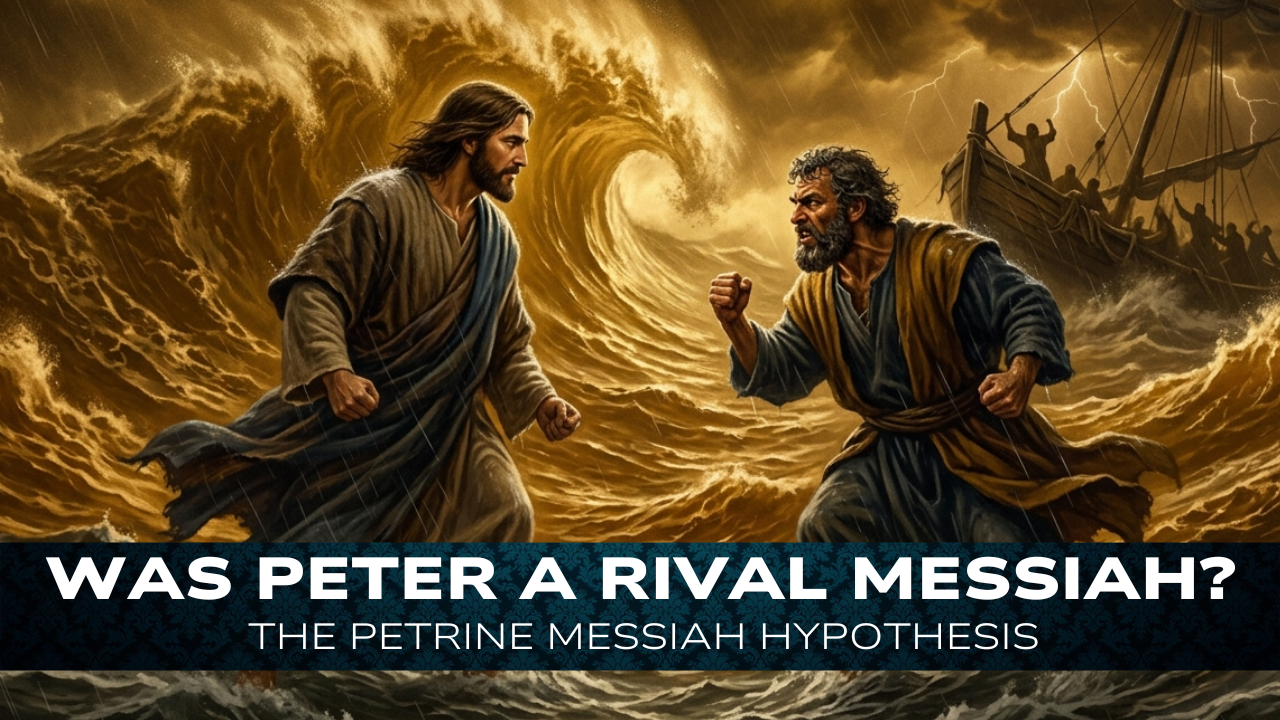
Peter on the Sea
Within the earliest Jesus movement, the sea may originally have functioned as a metaphor for those outside the Kingdom of God, the unstable world beyond the community of the saved. The “Sea of Galilee” did not exist until the Biblical authors used the phrase, as I point out in my previous video. Under this reading, stories about mastery over the sea were not initially intended as literal miracle reports, but as symbolic depictions of messianic authority and the power to bring people safely into the kingdom. The Gospel authors, however, appear to literalize these earlier metaphors into concrete narrative events. By transforming symbolic traditions into historical scenes, they are able to reshape Petrine imagery and subordinate Peter’s authority to Jesus within a dramatic literary framework.
Matthew 14:28–31 — Subverting the Sea
“But seeing the wind, he became frightened, and beginning to sink, he cried out, saying, ‘Lord, save me!’”
The focal point of Matthew’s unique addition to the walking on water narrative is Peter’s sudden, disastrous descent into the waves. In the original sea metaphor, walking on water would have indicated someone who was the Messiah. Matthew literalizes the metaphor and builds a corrective narrative frame around it. By forcing Peter out onto the stormy sea only at Jesus’s explicit command (“Come!”), the text strategically strips Peter of any autonomous miraculous power.
To completely neutralize Peter’s independent messianic status, the author has him panic, lose faith, and begin to drown the moment he relies on his own strength. His desperate cry, “Lord, save me!”, and Jesus’s immediate, physical rescue completely subvert the messianic tradition of Peter. The reader is guided to understand that Peter cannot master the sea on his own; he is entirely dependent on Jesus to keep him from being swallowed by the deep. Through this narrative spin, Peter’s sovereign authority is subverted into a story of a sinking, doubting disciple who must be rescued by Jesus.
John 21:3 — The Empty Nets
Simon Peter *said to them, “I am going fishing.” They *said to him, “We are also coming with you.” They went out and got into the boat; and that night they caught nothing.
The focal point of John’s fishing narrative is Peter’s complete, frustrating failure on the sea: “That night they caught nothing.” Fishing was originally a powerful metaphor for gathering people into the kingdom. To manage this tradition of Petrine autonomy, the author of John literalizes the metaphor and builds a corrective narrative frame around it. By showing Peter and his companions laboring through the dark only to come up completely empty-handed, the text strategically demonstrates that Peter’s independent efforts are entirely barren when operating outside of Jesus.
To completely subordinate Peter's leadership, the narrative requires the physical intervention of the resurrected Jesus, who commands them from the shore to cast the net on the right side of the boat. The resulting, supernatural catch of 153 large fish completely subverts the original tradition of Peter's autonomous success. The reader is guided to realize that Peter’s independent net is empty, and that he can only successfully gather people into the kingdom by obeying the direct orders of Jesus. Through this narrative spin, a well-known memory of Peter’s independent missionary triumphs is successfully spun into a story of absolute ministerial dependence on Jesus.
The Redactional Verdict
When we read these verses sequentially, we see a deliberate editorial trajectory. The text repeatedly allows Peter to do and say spectacular things, reflecting a historical tradition where he was a monumental, perhaps rival, figure.
But at every single turn, the canonical authors insert a narrative correction. They force Peter to confess Jesus (Mark 8:29, John 6:68), they have Jesus curse Peter's independent impulses (Mark 8:33), and they have Peter constantly remind the crowds that he is just a mortal man operating on borrowed power (Acts 3:12, 10:26). It is a masterclass in literary assimilation.
If an independent Petrine movement existed, these passages read exactly like the final, heavy-handed editorial stitches designed to sew that movement into the fabric of the Jesus tradition, ensuring Peter's followers were fully integrated and structurally subordinated.