Gospel of Mark: Was Jesus A Rogue Son?

Jesus out of control? A conflict between the Father and the Son? Who's idea was it to save the world anyway? Mark addresses the situation in his Gospel.

This is part of a series on mirror-reading the books of the Bible.  You can view all posts in the series here.  They are only cursory mirror-readings, and although I give evidence for their validity, further research is desired for support.

Mirror-Reading the Gospel Of Mark Gives Us A Greater Understanding

False teachers were arguing that, yes, Jesus did provide salvation for the Gentiles, but that was not God's plan.  Jesus was not loved by God and God disapproved of him.  Jesus was a son that had gone rogue, and saving the Gentiles was not God the Father's will. Mark responds to this false teaching in the Gospel of Mark.

How Mark Proved That Jesus Had Not Gone Rogue

Mark points out twice that Jesus is not just God the Father's son, but His beloved son.  There was no schism between the two, and God the Father was pleased with Jesus.

Mark 1:11
And a voice came from heaven, “You are my beloved Son; with you I am well pleased.”
Mark 9:7
And a cloud overshadowed them, and a voice came out of the cloud, “This is my beloved Son; listen to him.”

Secondly, when it came to the whole idea of dying on the cross for the sins of the world (including the Gentiles), Mark is sure to point out that it was, in fact, God the Father's will.

Mark 14:36
And he said, “Abba, Father, all things are possible for you. Remove this cup from me. Yet not what I will, but what you will.”

What Do You Think?

What do you think of this mirror-reading of Gospel of Mark?  @@Was Mark trying counter the idea that there was a schism between the Father and the Son?@@  What other situations do you think Mark was responding to?

Header Image PHOTO CREDIT: Mindaugas Danys cropped from original

Acts, Galatians and Mirror-Reading

Phillip J. Long has a nice post on mirror-reading over at Reading Acts. He suggests that Acts could be useful when mirror-reading Galatians. I absolutely agree. There are some concerns about Luke's theological agenda as a writer but as long as mirror-reading to discover the false teachings is primary, I don't think it's an issue, but rather an asset. I've discussed supporting texts for mirror-reading before in my video, Supporting Texts for Mirror-Reading A Book of the Bible

Ecclesiastes: Trying To Achieve The Perfect Life?

There was an ancient philosophy that taught how to achieve the perfect life.  The "Teacher" in Ecclesiastes responds to this philosophy.

This is part of a series on mirror-reading the books of the Bible.  You can view all posts in the series here.  They are only cursory mirror-readings and, although I give evidence for their validity, further research is desired for support.

Mirror-Reading The Book Of Ecclesiastes Gives Us A Greater Understanding

From the numerous references to youth and how to deal with the king, we can infer that the Book of Ecclesiastes was aimed at young courtiers who interacted with the king on occasion.  These courtiers had embraced, or were at least exploring, a philosophy that held that one could achieve a perfect life, perhaps even avoiding death.  This was achieved by going to extremes, either of wisdom and righteousness or folly and wickedness.  The results of this philosophy had caused them to become greedy, envious and oppressive of the poor.  They also tended to be argumentative to achieve what they wanted, spewing words at the king and even at God. The "Teacher" in Ecclesiastes teaches to counter this philosophy.

Six Points That The "Teacher" Uses To Shut Down The So Called Perfect Life Philosophy

1. The Teacher already tried the philosophy and it didn't work

The "Teacher" also called "Preacher" in some Bible translations, or "Koheleth" in the Hebrew, was also a king.  If anyone was able to go to the extremes, it would be him.  The pursuit of wisdom was upheld and encouraged in the wisdom literature of the Bible, but folly is never shown as something to be pursued.  However, the Teacher pursues both extremes because the author of Ecclesiastes is not responding to Biblical wisdom teachings but the so called "perfect life philosophy". 

Ecclesiastes 1:16-17 (see also 2:9)
I said in my heart, “I have acquired great wisdom, surpassing all who were over Jerusalem before me, and my heart has had great experience of wisdom and knowledge.” And I applied my heart to know wisdom and to know madness and folly. I perceived that this also is but a striving after wind.

This gives rise to one of the most bizarre passages when compared to the rest of the Bible:

Ecclesiastes 7:16-18
Be not overly righteous, and do not make yourself too wise. Why should you destroy yourself? Be not overly wicked, neither be a fool. Why should you die before your time? It is good that you should take hold of this, and from that withhold not your hand, for the one who fears God shall come out from both of them.

"Don't be too righteous" sounds odd but makes more sense when one realizes that the Teacher is responding to a philosophy that was promoting extremes in order to achieve a perfect life.

So the young courtiers are encouraged to not bother pursuing the philosophy because the Teacher already pursued both extremes, and concludes that it is a "chasing after the wind"

Ecclesiastes 2:12
So I turned to consider wisdom and madness and folly. For what can the man do who comes after the king? Only what has already been done.


2. God controls the good times and the bad times and they can't be changed

@@The Teacher explains that God sets the "times" and they can't be changed by extreme wisdom or folly@@.

Ecclesiastes 3:14-15
I perceived that whatever God does endures forever; nothing can be added to it, nor anything taken from it. God has done it, so that people fear before him. That which is, already has been; that which is to be, already has been; and God seeks what has been driven away.

What will be, will be and there is nothing the young courtiers could do about it.

Ecclesiastes 1:9
What has been is what will be,
    and what has been done is what will be done,
    and there is nothing new under the sun.

The young courtiers had been trying to make their paths straight by eliminating all the bad times, but the Teacher responds:

Ecclesiastes 7:13 (see also 1:15)
Consider the work of God:
    who can make straight what he has made crooked?

But God ordains all the times, both good and bad:

Ecclesiastes 3:1-8
For everything there is a season, and a time for every matter under heaven:
a time to be born, and a time to die;
a time to plant, and a time to pluck up what is planted;
a time to kill, and a time to heal;
a time to break down, and a time to build up;
a time to weep, and a time to laugh;
a time to mourn, and a time to dance;
a time to cast away stones, and a time to gather stones together;
a time to embrace, and a time to refrain from embracing;
a time to seek, and a time to lose;
a time to keep, and a time to cast away;
a time to tear, and a time to sew;
a time to keep silence, and a time to speak;
a time to love, and a time to hate;
a time for war, and a time for peace.
Ecclesiastes 3:17
 I said in my heart, God will judge the righteous and the wicked, for there is a time for every matter and for every work.


3. They can't know the future

Although there are plenty of examples of prophets of God foretelling the future, the young courtiers thought they could foretell the future with wisdom.  The Teacher said that's impossible.

Ecclesiastes 3:11
He has made everything beautiful in its time. Also, he has put eternity into man's heart, yet so that he cannot find out what God has done from the beginning to the end.
Ecclesiastes 6:12
For who knows what is good for man while he lives the few days of his vain life, which he passes like a shadow? For who can tell man what will be after him under the sun?
Ecclesiastes 8:17
then I saw all the work of God, that man cannot find out the work that is done under the sun. However much man may toil in seeking, he will not find it out. Even though a wise man claims to know, he cannot find it out.
Ecclesiastes 7:14
In the day of prosperity be joyful, and in the day of adversity consider: God has made the one as well as the other, so that man may not find out anything that will be after him.
Ecclesiastes 11:3-6
If the clouds are full of rain,
    they empty themselves on the earth,
and if a tree falls to the south or to the north,
    in the place where the tree falls, there it will lie.
He who observes the wind will not sow,
    and he who regards the clouds will not reap.
As you do not know the way the spirit comes to the bones in the womb of a woman with child, so you do not know the work of God who makes everything.
In the morning sow your seed, and at evening withhold not your hand, for you do not know which will prosper, this or that, or whether both alike will be good.
Ecclesiastes 9:11
Again I saw that under the sun the race is not to the swift, nor the battle to the strong, nor bread to the wise, nor riches to the intelligent, nor favor to those with knowledge, but time and chance happen to them all.

Although all of the times were planned by God, they would not be able to figure out what the plan was, so that "time and chance" happened to them all.

4. Shut your mouth

The Teachers also addresses the issue of being argumentative in order to achieve their desires:

Ecclesiastes 5:2
Be not rash with your mouth, nor let your heart be hasty to utter a word before God, for God is in heaven and you are on earth. Therefore let your words be few.
Ecclesiastes 6:10
Whatever has come to be has already been named, and it is known what man is, and that he is not able to dispute with one stronger than he.
Ecclesiastes 10:14
A fool multiplies words,
    though no man knows what is to be,
    and who can tell him what will be after him?
Ecclesiastes 6:11
The more words, the more vanity, and what is the advantage to man?

5. They will die eventually

All of their wisdom and folly would not be able to save them from death.  

Ecclesiastes 9:1-3
But all this I laid to heart, examining it all, how the righteous and the wise and their deeds are in the hand of God. Whether it is love or hate, man does not know; both are before him. It is the same for all, since the same event happens to the righteous and the wicked, to the good and the evil, to the clean and the unclean, to him who sacrifices and him who does not sacrifice. As the good one is, so is the sinner, and he who swears is as he who shuns an oath. This is an evil in all that is done under the sun, that the same event happens to all. Also, the hearts of the children of man are full of evil, and madness is in their hearts while they live, and after that they go to the dead.
Ecclesiastes 7:2
It is better to go to the house of mourning
    than to go to the house of feasting,
for this is the end of all mankind,
    and the living will lay it to heart.
Ecclesiastes 8:8
No man has power to retain the spirit, or power over the day of death. There is no discharge from war, nor will wickedness deliver those who are given to it.
Ecclesiastes 9:10
Whatever your hand finds to do, do it with your might, for there is no work or thought or knowledge or wisdom in Sheol, to which you are going.

6. Enjoy life

After destroying the philosophy that the young courtiers were pursuing, the Teacher gives guidance on how they then should live:

Ecclesiastes 2:24
There is nothing better for a person than that he should eat and drink and find enjoyment in his toil. This also, I saw, is from the hand of God,
Ecclesiastes 5:18
Behold, what I have seen to be good and fitting is to eat and drink and find enjoyment in all the toil with which one toils under the sun the few days of his life that God has given him, for this is his lot.
Ecclesiastes 5:19
Everyone also to whom God has given wealth and possessions and power to enjoy them, and to accept his lot and rejoice in his toil—this is the gift of God.
Ecclesiastes 3:22
So I saw that there is nothing better than that a man should rejoice in his work, for that is his lot. Who can bring him to see what will be after him?
Ecclesiastes 8:15
And I commend joy, for man has nothing better under the sun but to eat and drink and be joyful, for this will go with him in his toil through the days of his life that God has given him under the sun.

Herding the Courtiers

@@The narrator of Ecclesiastes echoes the Teacher and warns the young courtiers not to go to extremes@@.

Ecclesiastes 12:11-12
The words of the wise are like goads, and like nails firmly fixed are the collected sayings; they are given by one Shepherd.  My son, beware of anything beyond these. Of making many books there is no end, and much study is a weariness of the flesh.

Goads and nails were used by shepherds to keep the sheep from straying.  Likewise, the narrator uses the terms to describe the words of the Teacher to keep the young courtiers from straying into extremes.

What Do You Think?

What do you think of this mirror-reading of Ecclesiastes?  Was the Teacher addressing young courtiers trying to achieve the perfect life?  What other situations do you think Ecclesiastes was responding to?


Are These Bible Verses Supposed To Be There?

What if there were verses lurking about in your Bible that weren't supposed to be there?  What kind of impact would it have on your interpretation of the Bible?  Would you want to know which one's they were? Keep reading to learn a couple of ways to identify these rogue verses.

If You Know Where The Interpolations Are, You May Get A Better Understanding Of The Bible

Sometimes when scribes would copy the Scriptures, they would add notes in the margins.  And sometimes, those notes were inserted into the text by a later scribe.  When that happens, it's referred to as an "interpolation".  Some interpolations are more obvious than others.  Most Bibles do good job of noting the obvious ones. Some interpolations could just be honest mistakes.  Some may be slightly more suspicious, and foul play may be involved.  Take 1 John 5:7-8 for example. In 1516, a man by the name of Desiderius Erasmus was working on a Greek New Testament called the Textus Receptus.  The Roman Catholic Church felt there was missing something.  See below for a comparison.

Roman Catholic

For there are three that bear witness in heaven: the Father, the Word, and the Holy Spirit; and these three are one. And there are three that bear witness on earth: the Spirit, and the water, and the blood; and these three agree as one.

Desiderius

For there are three that testify: the Spirit, and the water, and the blood; and these three agree as one.

At the time, Desiderius only had 6 manuscripts to work from, but none of them had the Roman Catholic version.  He requested the Roman Catholic Church to provide a manuscript with the additional text.  They did, but all the pages looked the same except the pages with the additional text. Foul play? Desiderius eventually did include the additional text but added a long footnote regarding the matter.  Thankfully, most Bibles either exclude the additional text or add a note indicating that it was unlikely part of the original manuscript.  Biblical interpolations are a reality.  Learn how to deal with it.

2 Ways You Can Tell If A Bible Verse Is An Impostor

1. Manuscript Evidence

We are blessed to have lots of manuscript evidence for the Bible.  There are more ancient manuscripts of the Bible than any other ancient piece of literature.  A lot more.  Many think of the transmission of Biblical manuscripts as a phone game, but with multiple lines of transmission, that's not the case.  It's like having 1010 pieces to a 1000 piece puzzle. We can compare and contrast the manuscripts to check for interpolations.  If a verse is missing or located in different places in the manuscripts, then it is most likely an interpolation.

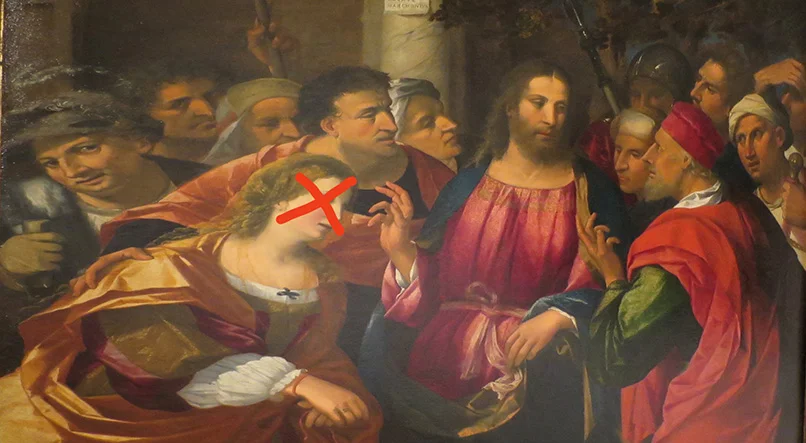
Remember that moving scene in Mel Gibson's "The Passion", where they bring the woman caught in adultery to Jesus?  Probably never happened.  It's hard to argue with "Let him without sin cast the first stone" and "Go and sin no more" but the reality is that the passage doesn't show up in any manuscripts until the 5th century, and when it does, it floats around in different places.  It is most likely an interpolation and not part of the original manuscript.

Another passage that may be an interpolation is the entire ending of the Gospel of Mark. Mark 16:9-20 is the passage in question and it's easy to see why someone would add it, since without it, Mark has a rather abrupt ending. Although still debated, the manuscripts we have offer 4 different endings and raises doubts about Mark 16:9-20.

2. Chiastic Structure

If you don't know about chiastic structures, please read my previous post. Since chiastic structures are symmetrical, if that symmetry is broken by a verse, then we have reason to believe that it is an interpolation. When Jesus sweats blood in Luke 22:44, it's already sketchy because of weak manuscript evidence, but some also point to a chiastic structure that runs through verses 40-46.  Here is the chiasmus below without verse 44.

Jesus says to his disciples to pray so that they will not enter into temptation.
     He withdraws from the disciples.  
          He kneels down and prays.  
               He prays and an angel strengthens him.
          He arises from praying.
     He returns to the disciples.
He tells them to pray so that they will not enter into temptation.

The appearance of verse 44 after the angel strengthens Jesus would seem out of place if the chiasmus above is correct, but there are several scholars who argue it is not, and so the debate shifts to the chiastic structure.

There are other ways to determine if a verse is an interpolation or not, such as internal, linguistic and theological consistency, but those quickly become technical in nature and hotly debated among scholars.  I think mirror-reading could be utilized in this regard too.  It could be used to check for "situational" consistency.


2 Thessalonians: Can You Have Christ Without God?

Persecution and an alarming rumor had the Thessalonians drawing a false distinction.  Paul steps in to bring it all back together.

This is part of a series on mirror-reading the books of the Bible.  You can view all posts in the series here.  They are only cursory mirror-readings and, although I give evidence for their validity, further research is desired for support.

Mirror-Reading 2nd Thessalonians Gives Us A Greater Understanding

The Thessalonians had been experiencing persecution.  On top of that, they had heard that Christ had already returned.  This led to the idea that God only favored some of those who believed in Christ - only the ones who were chosen - and they were not chosen since they were being persecuted.  They thought that only some churches were churches of God and that other churches did not have His favor (grace).

How Paul Showed The Thessalonians All Was Good With God AND Christ.

Paul addresses the issue by using the conjunction "and" which connects both God and Christ.  Paul sometimes used conjunctions to correct false teachings. In doing this, he shows how those in Christ also have God's favor.

2 Thessalonians 1:1-2
Paul, Silvanus, and Timothy, To the church of the Thessalonians in God our Father and the Lord Jesus Christ: Grace to you and peace from God our Father and the Lord Jesus Christ.
2 Thessalonians 1:12
so that the name of our Lord Jesus may be glorified in you, and you in him, according to the grace of our God and the Lord Jesus Christ.
2 Thessalonians 2:16-17
Now may our Lord Jesus Christ himself, and God our Father, who loved us and gave us eternal comfort and good hope through grace, comfort your hearts and establish them in every good work and word.
2 Thessalonians 3:5
May the Lord direct your hearts to the love of God and to the steadfastness of Christ.

Paul assures that they are chosen by God:

2 Thessalonians 2:13-14
But we ought always to give thanks to God for you, brothers beloved by the Lord, because God chose you as the firstfruits to be saved, through sanctification by the Spirit and belief in the truth. To this he called you through our gospel, so that you may obtain the glory of our Lord Jesus Christ.

Secondly, Paul corrects the misconception that Christ had already returned:

2 Thessalonians 2:2
not to be quickly shaken in mind or alarmed, either by a spirit or a spoken word, or a letter seeming to be from us, to the effect that the day of the Lord has come.

And that he boast about their persecutions in the churches "of God":

2 Thessalonians 1:4
Therefore we ourselves boast about you in the churches of God for your steadfastness and faith in all your persecutions and in the afflictions that you are enduring.

Paul even uses the conjunction "and" in the negative sense. Those who will suffer God's wrath will not know God or Christ:

2 Thessalonians 1:8
 in flaming fire, inflicting vengeance on those who do not know God and on those who do not obey the gospel of our Lord Jesus.

He makes it clear that ALL in Christ will be saved:

2 Thessalonians 1:10 (see also 2:12, 3:16 and 3:18)
when he comes on that day to be glorified in his saints, and to be marveled at among all who have believed, because our testimony to you was believed.

What Do You Think?

What do you think of this mirror-reading of 2 Thessalonians?  @@Was Paul trying correct a false distinction between the churches of God and the churches of Christ@@?  What other situations do you think 2 Thessalonians was responding to?

Header Image PHOTO CREDIT: midiman cropped from original

Outlining A Book Of The Bible? You're Doing It Wrong

The key to outlining a book of the Bible is to make sure you structure it the way an ancient Hebrew would.  If you outline without knowing this ancient way, then you'll be missing out on a deeper understanding of the book that you're studying, or even worse, if you try to force the book into a typical outline, you could completely misunderstand what the Biblical author was trying to say.  Knowing how to outline correctly can help you understand where the author was placing emphasis, and it can even help you remember Scriptures better.

Knowing How Ancient Writers Structured Their Writings Can Help Us Understand Them Better

Several years ago, I was trying to outline Genesis, but the more I tried, the more it seemed like it had no structure.  It just seemed like random stories were just arbitrarily thrown together.  Sure, I could have forced it into an outline and ignored the things that didn't seem to fit, but I wondered to myself if perhaps the ancient Hebrews structured there writing differently than we do.  Turns out they did, and it's called chiastic structure.  @@It's time to stop forcing books of the Bible into outlines they were never intended for@@. They may be using a chiastic structure instead.

How Chiastic Structure Works

The typical Western style outline looks something like this:

I. Introduction
       A. Sub point 1
       B. Sub point 2
II. Point 1
       A. Sub point 1
       B. Sub point 2
III. Point 2
       A. Sub point 1
       B. Sub point 2
IV. Point 3
       A. Sub point 1
       B. Sub point 2
V. Conclusion

Chiastic structure is more cyclical in nature. It looks like this:

A
       B
              C
                     X
              C'
       B'
A'

A chiasmus uses inverted parallelisms so that the words or idea in A is somehow reflected in A′.
X marks the main point and is somewhat similar to the “conclusion” in the Western outline.

Here's a chiasmus from Genesis 17:1-25:

A    Abram's age
B        The LORD appears to Abram
C            God's first speech
D                Abram falls on his face
E                    God's second speech (Abram's name changed, kings)
X                        God's Third Speech (Covenant of circumcision)
E'                   God's fourth speech (Sari's name changed, kings)
D'               Abraham falls on his face
C'           God's fifth speech
B'       God "goes up" from Abraham
A'   Abraham's age

Chiastic structure can be contained within a few verses or span entire books.  There can also be chiastic structures within chiastic structures, creating complexity and beauty that some consider to be poetic.  

This type of structure can also assist in helping you remember the Scriptures.  If you can remember A, then you know that A' is reflected in some way.  This was helpful in the ancient world when most teaching was orally, and the literacy rate was low.

It's also helpful to know where the author's main point is in the structure.  If the main point is in the middle, and you are looking for it at the end (the conclusion), then you'll be off the mark.

Chiastic structure is much more prominent in the Old Testament, but there are plenty in the New Testament.  If you don't feel that a book uses chiastic structure, then don't force it into one.  Each book is unique and you'll have to determine whether it uses a chiastic structure or not.

Chiastic Structure And Mirror-Reading

Chiastic structure can be beneficial when mirror-reading.  Not only does it help you grasp the overall structure of the book, but can also be useful in identifying key themes and reoccurring word/phrases, which is good to know when mirror-reading.


Book of Enoch: Was Enoch In Cahoots With The Fallen Angels?

enoch.jpg

Update: I’ve revised my view on Enoch and provide more details in a video series on The Book of the Watchers

By reconstructing the problem that the Book of Enoch was responding to, we can see that Enoch had gotten a bad reputation. 

This is part of a series on mirror-reading the books of the Bible.  You can view all posts in the series here.  They are only cursory mirror-readings and, although I give evidence for their validity, further research is desired for support.

I don't normally mirror-read extra-Biblical books but since the Book of Enoch is quoted in Jude and alluded to in 2 Peter and possibly elsewhere in the New Testament, I thought it would be beneficial to have a look at it. 

There are several sections to the Book of Enoch that seem to have been written at different times. For this post, I'll be focusing on the section referred to as "The Book of Watchers", specifically chapters 6-16.

Mirror-Reading The Book of Enoch Gives Us A Greater Understanding

The Watchers are often thought of as fallen angels, but only some of them fell and actually, they didn't really fall.  They came down out of heaven by their own choice, although they weren't supposed to.  They hooked up with some human women and got them pregnant and their children became giants and caused all sorts of problems.

Centuries later the people in ancient Israel were still dealing with issues that they thought stemmed from these Watchers.  The giants were gone but they thought the Watchers were still on earth causing trouble.  The Israelites knew that the prophet Enoch was intertwined with the story of the Watchers, but they didn't know the whole story and this was causing some problems for Enoch's reputation.

Some Israelites had heard of, or perhaps even read, a petition written by Enoch.  The petition asked that God forgive the Watchers that had come down to earth. The petition didn't say what God's response was, so the people just assumed that God had forgiven them since it seemed like they were still having trouble with the Watchers.

@@What kind of prophet would petition to have the Watchers forgiven?@@  He must have been an evil one!  

3 Ways The Author Of The Book Of Enoch Restored Enoch's Reputation

1. Enoch described as a righteous scribe

The writer of the Book of Enoch is sure to describe Enoch as righteous. Not only that, but that Enoch was also a scribe.  That was his job.  Just because he wrote something didn't mean that he endorsed it. He worked with the Watchers, both good and bad.  

Enoch 12:3-4
And I, Enoch was blessing the Lord of majesty and the King of the ages, and lo! the Watchers called me--Enoch the scribe--and said to me: 'Enoch, thou scribe of righteousness, go, declare to the Watchers of the heaven who have left the high heaven, the holy eternal place, and have defiled themselves with women, and have done as the children of earth do, and have taken unto themselves wives: "Ye have wrought great destruction on the earth:

Enoch 14:1
The book of the words of righteousness, and of the reprimand of the eternal Watchers in accordance with the command of the Holy Great One in that vision.

Enoch 15:1-2
And He answered and said to me, and I heard His voice: 'Fear not, Enoch, thou righteous man and scribe of righteousness: approach hither and hear my voice. 2. And go, say to the Watchers of heaven, who have sent thee to intercede for them: "You should intercede" for men, and not men for you:


2. The Petition was not granted

God did not forgive the Watchers on earth, and the author of the Book of Enoch points out in several places that the petition that Enoch wrote was thoroughly rejected.

Enoch 10:10
And no request that they (i.e. their fathers) make of thee shall be granted unto their fathers on their behalf; for they hope to live an eternal life, and that each one of them will live five hundred years.'

Enoch 12:5-6
And ye shall have no peace nor forgiveness of sin: and inasmuch as they delight themselves in their children, The murder of their beloved ones shall they see, and over the destruction of their children shall they lament, and shall make supplication unto eternity, but mercy and peace shall ye not attain."'

Enoch 13:1-10
And Enoch went and said: 'Azâzêl, thou shalt have no peace: a severe sentence has gone forth against thee to put thee in bonds: And thou shalt not have toleration nor request granted to thee, because of the unrighteousness which thou hast taught, and because of all the works of godlessness and unrighteousness and sin which thou hast shown to men.' Then I went and spoke to them all together, and they were all afraid, and fear and trembling seized them. And they besought me to draw up a petition for them that they might find forgiveness, and to read their petition in the presence of the Lord of heaven. For from thenceforward they could not speak (with Him) nor lift up their eyes to heaven for shame of their sins for which they had been condemned. Then I wrote out their petition, and the prayer in regard to their spirits and their deeds individually and in regard to their requests that they should have forgiveness and length 〈of days〉. And I went off and sat down at the waters of Dan, in the land of Dan, to the south of the west of Hermon: I read their petition till I fell asleep. And behold a dream came to me, and visions fell down upon me, and I saw visions of chastisement, and a voice came bidding (me) I to tell it to the sons of heaven, and reprimand them. And when I awaked, I came unto them, and they were all sitting gathered together, weeping in ’Abelsjâîl, which is between Lebanon and Sênêsêr, with their faces covered. And I recounted before them all the visions which I had seen in sleep, and I began to speak the words of righteousness, and to reprimand the heavenly Watchers.

Enoch 14:3-4
As He has created and given to man the power of understanding the word of wisdom, so hath He created me also and given me the power of reprimanding the Watchers, the children of heaven. I wrote out your petition, and in my vision it appeared thus, that your petition will not be granted unto you throughout all the days of eternity, and that judgement has been finally passed upon you: yea (your petition) will not be granted unto you.

Enoch 14:7
And your petition on their behalf shall not be granted, nor yet on your own: even though you weep and pray and speak all the words contained in the writing which I have written.

Enoch 16:4
Say to them therefore: "You have no peace."'


3. The Watchers were no longer free to cause trouble

After Enoch's petition was rejected, God took steps to restrain the Watchers that had caused trouble so that they could no longer cause trouble on the earth - ever. However, the disembodied spirits of their giant offspring could and did cause trouble.

Enoch 10:12
And when their sons have slain one another, and they have seen the destruction of their beloved ones, bind them fast for seventy generations in the valleys of the earth, till the day of their judgement and of their consummation, till the judgement that is for ever and ever is consummated.

Enoch 14:5
And from henceforth you shall not ascend into heaven unto all eternity, and in bonds of the earth the decree has gone forth to bind you for all the days of the world.

Enoch 15:8-11
And now, the giants, who are produced from the spirits and flesh, shall be called evil spirits upon the earth, and on the earth shall be their dwelling. Evil spirits have proceeded from their bodies; because they are born from men, and from the holy Watchers is their beginning and primal origin; they shall be evil spirits on earth, and evil spirits shall they be called. As for the spirits of heaven, in heaven shall be their dwelling, but as for the spirits of the earth which were born upon the earth, on the earth shall be their dwelling. And the spirits of the giants afflict, oppress, destroy, attack, do battle, and work destruction on the earth, and cause trouble: they take no food, but nevertheless hunger and thirst, and cause offenses. And these spirits shall rise up against the children of men and against the women, because they have proceeded from them.

What Do You Think?

What do you think of this mirror-reading of the Book of Enoch?  Was the author of the Book of Enoch trying to restore Enoch's reputation?  What other situations do you think the Book of Enoch was responding to?

Header Image PHOTO CREDIT: Felipe Gabaldón cropped from original

How To Choose A Bible Commentary And Why You Should NOT Use One

There are 9 rules that will help you determine which Bible commentary to get.  But should you even use one in the first place?  We'll take a look at when and if you should use one.

The Right Commentary Will Offer Depth And Challenge Your Theology

A simple search for "[Book of the Bible] Commentary" will bring up a near endless list of commentaries.  How do you cut through the clutter?  How can you tell which offer the most value? If you're new to the Bible, it's hard to tell which are the good ones and which are the bad ones.  Even worse, you may have a bad one and not even know it!  The 9 rules below will help you navigate the overwhelming world of Biblical commentaries and narrow it down to a more manageable selection.

9 Rules For Choosing A Bible Commentary

1.  Avoid whole Bible commentaries

Look for a commentary that addresses only the book of the Bible that you are studying.  Commentaries that address the entire Bible just don't have the space to tackle the text in depth.

2. Avoid a set of commentaries by one author

An entire set limits you with one perspective and may not be as thorough as individual commentaries. Buy individual commentaries as you study through the different books of the Bible.    The same goes for buying a whole set of a particular series, since the quality may vary, so avoid them if you can.  

3. Pick a scholarly commentary, not a devotional/expository/popular commentary

A scholarly commentary will give greater depth and interact with the Biblical text in a much more serious way than a devotional commentary.  Devotional commentaries do serve a purpose and give practical application but they are basically written sermons that don't offer what the serious Bible student is looking for.  Matthew Henry, Everyman’s Bible Commentary, J. Vernon McGee’s notes and Warren Wiersbe’s commentaries are not what you're looking for. However, some scholarly commentaries can be quite technical, so if you're not quite at that level, look for a scholarly work that is a little more readable and geared for the general public.  The following rules will better define what a scholarly commentary is like.

4. Verse by verse

A good scholarly commentary will examine the Scriptures verse by verse - word by word even.  It will let the text speak for itself and give a detailed analysis.  Avoid commentaries that briefly review the text and then pontificate the author's favorite theology.

5. Interacts with extra-Biblical literature

Extra-Biblical literature can add additional insight to the Scriptures.  We now have many manuscripts and ancient texts to draw from and if your commentary doesn't utilize these, you're missing out!  Not only can ancient Jewish works, such as the Book of Enoch and the Book of Jubilees help give historical and cultural background but ancient texts of the surrounding cultures of Israel provide helpful information.

6. Original languages

Look for a commentary that interacts with the original languages.  The author should be competent in the Greek, Hebrew or Aramaic that is relevant to the text.

7. Newer

It's not that today's commentators are better or smarter than their predecessors, it's that they have so many more resources.  We've had so many archaeological finds and ancient texts discovered just in the last century.  Today's technology also gives commentators a huge advantage.  Personal computers and Bible software can greatly assist in research.

8. Go digital

As impressive as a set of physical commentaries can look on a bookshelf, you really should go digital if you can.  Bible software such as Logos will link to other helpful resources that you use in the software.  At the very least get something that is searchable on a computer.

9. Look for commentators that are open to mirror-reading

Not all commentators are open to mirror-reading because of its controversial nature. Look for a mirror-reading friendly commentary.  Be warned though, just because they mirror-read does not mean they mirror-read well.  Judge their mirror-reading for yourself and use the information from this site to help analyze it.  Here are a few commentators that are at least open to mirror-reading: John M. G. Barclay, Nijay K. Gupta, Douglas Moo, Ralph P. Martin, David Garland, and Robert Jewett,

Should You Use A Bible Commentary?

Everyone is different but in short, the answer is no... at least, not at first. Give yourself a chance to get to read the text and get to know it.  Read it over and over and over and over... you get the idea.  You basically want to do a Vulcan mind meld with it, so to speak.  Simply reading your Bible is not considered "research" but it will give you a chance to become familiar with the themes, keywords and phrases.  @@Get to know the Book of the Bible you are studying before being challenged by a commentary@@.

On the other hand, if you're already familiar with the book of the Bible that you are studying and have already gone through a commentary or two, then you may find articles from academic journals helpful.  Journals narrow their focus on very particular parts of Scripture. Websites such as Sage Journal provide access to many journals, sometimes for free.

Header Image PHOTO CREDIT: brett jordan cropped from original

1 Thessalonians: Why Did They Despise Prophecies?

The Thessalonians were afraid that God was going to drop the hammer on them.  Paul drop-kicks that false teaching!

This is part of a series on mirror-reading the books of the Bible.  You can view all posts in the series here.  They are only cursory mirror-readings and, although I give evidence for their validity, further research is desired for support.

Mirror-Reading 1 Thessalonians Gives Us A Greater Understanding

False teachers came to the Thessalonian Church and shared some Old Testament prophecies with them.  Those prophecies sounded like God was going to destroy the Gentiles when the Messiah came. This was a problem, since the Thessalonians were Gentiles.  Naturally, the Thessalonians didn't care for those prophecies. One might even say they "despised them".  Fortunately, the apostle Paul responded to the false teaching and let the Thessalonians know they were not in danger of God's wrath.

How Paul Showed The Thessalonians Why They Didn't Need To Despise Prophecies Any Longer

Paul states plainly that they will not be under God's wrath:

1 Thessalonians 1:10
and to wait for his Son from heaven, whom he raised from the dead, Jesus who delivers us from the wrath to come.
1 Thessalonians 5:9
For God has not destined us for wrath, but to obtain salvation through our Lord Jesus Christ,

Paul also takes some swipes at the false teachers.  They had been using the Old Testament prophets to try to Judaize the Thessalonians, but Paul points out that they were the type of people who had killed the Old Testament prophets they were quoting!

1 Thessalonians 2:15
 who killed both the Lord Jesus and the prophets, and drove us out, and displease God and oppose all mankind

Then Paul turns the tables and says that God's wrath had come on the false teachers!

1 Thessalonians 2:16
by hindering us from speaking to the Gentiles that they might be saved—so as always to fill up the measure of their sins. But wrath has come upon them at last!

One of the Old Testament passages that the false teachers were likely using is found in Isaiah, were he describes how God will wear His armor when destroying the Gentiles.

Isaiah 59:17
 “He put on righteousness as a breastplate, and a helmet of salvation on his head; and he put on garments of vengeance for clothing, and was clad with zeal as a mantle.”

However, Paul encourages the Thessalonians to put on the armor that was originally intended to destroy them!

1 Thessalonians 5:8
But since we belong to the day, let us be sober, having put on the breastplate of faith and love, and for a helmet the hope of salvation.

Finally, this leads Paul to let the Thessalonians know they have no reason to despise those Old Testament prophecies that the false teachers were using against them:

1 Thessalonians 5:20
Do not despise prophecies,

Many assume that the prophecies being despised were ones given by the prophets in the Church at that time.  If the prophecies that Paul was referring to were those type of prophecies, then we would expect to find Paul dealing with that issue in the letter, much like he did in 1 Corinthians 13. However, we do not find any evidence of this. We do however, find plenty of references to the Day of the Lord, which is referenced numerous time in Old Testament prophecies.  It was the day that the Thessalonians had feared would bring God's wrath on them, but Paul shows that day, which is the 2nd coming of Christ, is nothing to fear.

1 Thessalonians 2:19 (see also 3:13, 4:15-16, 5:2 and 5:23)
For what is our hope or joy or crown of boasting before our Lord Jesus at his coming? Is it not you?.

What Do You Think?

What do you think of this mirror-reading of 1 Thessalonians?  Was Paul trying to assure the Thessalonians that they would not experience God's wrath during the Day of the Lord?  What other situations do you think 1 Thessalonians was responding to?


Find Out Which Way You Interpret The Bible

@@Ever wonder why someone interprets a verse entirely different than you?@@  Especially when you think the meaning is so obvious?  Ever have an argument with someone about the Bible, where it seems like you are just talking past each other or talking in circles?  One reason that happens could be because they have an entirely different approach to the Bible than you do.  There are several perspectives to take when reading the Bible, some healthy and some not so healthy.  We'll take a look at 3 different ways to interpret the Bible.

Knowing These 3 Ways Will Help You To Better Understand Others - And Yourself

There's a popular worship song with the phrase "He gives and takes away".  One church lady didn't like that phrase and asked God how He could "take away".  She said, He answered her by saying that He gives the good but takes away the bad.  However, this stands in contrast with the context of the Book of Job where God does take away the good. So is she wrong?

Biblical scholar, D.A. Carson tells of a time that a man told him the meaning of a verse in the Gospel of Matthew.  D.A. Carson told that man he was wrong and clearly laid out why the man's interpretation was not possible.  However, the man still held to his interpretation even thought he couldn't deny Carson's facts.  Why?

Hopefully, the following 3 ways of interpreting the Bible with shed light on how you and other people understand your Bibles.  There are definitely wrong ways to interpret the Bible, but there are multiple right ways.  @@The Bible is multi-dimensional and understanding the dimensions may help us understand others@@.

The 3 Ways: Eisogesis, Exegesis And ExePneuma

1. Eisogesis

Eisogesis literally means "into the text" and it is one of the unhealthy ways to read your Bible.  Sometimes called "proof-texing", it's when people read their own meaning into the text or they may cherry pick a verse to support their theology, even though it contradicts the context of the verse.  An obvious example of this would be if someone said that Psalm 14:1 says that "There is no God".  However, the full verse is: The fool says in his heart, "There is no God."

Less obvious are verses such as Jeremiah 29:11:

For I know the plans I have for you,” declares the Lord, “plans to prosper you and not to harm you, plans to give you hope and a future.

It's funny that no one ever mentions the verse just a few chapters before:

And I myself will fight against you with an outstretched hand and with a strong arm, even in anger, and in fury, and in great wrath.
-Jeremiah 21:5

Both verses need to be read in context and shouldn't be cherry picked to use how anyone sees fit.

2. Exegesis

Exegesis means "out of the text", because when you're doing exegesis, you are trying to derive the meaning from the text and not reading your own meaning into it.  There are two main methods for doing exegesis.  They are called the historical-grammatical method and the allegorical method.

The historical-grammatical method tries to determine the original authorial intent.  In other words, what was the original author trying to say to the original reader? This method relies a lot on contexts.  It looks at literary context, historical context, and cultural context, to name a few.  I would consider mirror-reading to be part of the historical-grammatical method, as it tries to reconstruct the "situational context".  In other words, what was the situation that the original author was writing or responding to?  If you don't know about mirror-reading, be sure to subscribe.

The allegorical method sees the Bible as metaphor or analogy and tends to be more popular within the Eastern Orthodox Church. Here is an example about the Parable of the Good Samaritan from one of the great Church theologians, Augustine. Theologian, C. H. Dodd, summarizes:

"...the man is Adam, Jerusalem the heavenly city, Jericho the moon – the symbol of immortality; the thieves are the devil and his angels, who strip the man of immortality by persuading him to sin and so leave him (spiritually) half dead; the priest and levite represent the Old Testament, the Samaritan Christ, the beast his flesh which he assumed at the Incarnation; the inn is the church and the innkeeper the apostle Paul."

The difficult thing about the allegorical method is that it's hard to say whether it's correct or not.  It doesn't rely on context like the historical-grammatical method does and so it's hard to prove or disprove.

3. ExePneuma

@@Do you use ExePneuma when you interpret the Bible?@@ It's a term that I made up, and it means "out of the Spirit".   It seems to be a popular way that people interpret the Bible, especially among Charismatic Christians.  It's when the meaning of the text is revealed or inspired by the Holy Spirit.  Depending on your theology, this may not even be considered a possibility.  However, whether you believe it can be out of the Spirit or not, there are definitely some people that do believe that it can be.

It can be confused with eisogesis since it can appear that one is simply reading their own meaning into the text.  It's also similar to the allegorical method, since it is difficult to prove or disprove.

Recognize How You And Others Interpret The Bible.

There are other ways to interpret the Bible but the 3 ways listed above will probably be what you'll encounter when talking with others. When discussing Scriptures with others, be sure to understand which of the 3 ways they are interpreting the Bible.  It may not help you agree with each other, but at least you will know why they see things so differently and may help avoid unnecessary arguments.

Header Image PHOTO CREDIT: brett jordan cropped from original


Is There A Hidden Message In Habakkuk?

When the Babylonian army was steaming towards Jerusalem, Habakkuk levels some harsh words against the impending invaders, but hidden in those words is a warning to the Jews.

This is part of a series on mirror-reading the books of the Bible.  You can view all posts in the series here.  They are only cursory mirror-readings and, although I give evidence for their validity, further research is desired for support.

Mirror-Reading The Book of Habakkuk Gives Us A Greater Understanding

The Babylonian army had become the deadliest military force on earth.  They were obliterating ancient near east cities like it was going out of style and they were heading towards Jerusalem. The Assyrian army had laid siege to Jerusalem years before but Yahweh had saved the day then, sending the Assyrians away, never to return.  This time though, God had made no promises to save them, and the future looked bleak. With a dire outlook, there were temptations for those in Jerusalem and perhaps others in Judah.  Habakkuk addresses all of the issues they faced in a clever, even poetic way.

6 Hidden Messages In Habakkuk

Habakkuk fires five "woes" at Babylon.  The metaphors in them are clearly directed at the powerful empire. However, the principles in those "woes" are also subtly directed at the temptations facing the Jews.

1. Take care of your debt

An impending siege of a city would wreak havoc on the credit system.  Why pay back your creditors if you'll be given a clean slate after Jerusalem falls?  Habakkuk addresses the issue:

Habakkuk 2:6-7
Shall not all these take up their taunt against him, with scoffing and riddles for him, and say,
“Woe to him who heaps up what is not his own—
    for how long?—
    and loads himself with pledges!”
Will not your debtors suddenly arise,
    and those awake who will make you tremble?
    Then you will be spoil for them.

The statement is directed at the Babylon because they were taking cities that weren't theirs.  However, it also applied to the Jew who was thinking about gaming the credit system.

2. Don't make a deal with the enemy to save your own hide

The Jews may have been tempted to sell out their countrymen to avoid calamity in a potential siege.  Habakkuk responds:

Habakkuk 2:9-12
“Woe to him who gets evil gain for his house,
    to set his nest on high,
    to be safe from the reach of harm!
You have devised shame for your house
    by cutting off many peoples;
    you have forfeited your life.
For the stone will cry out from the wall,
    and the beam from the woodwork respond.
“Woe to him who builds a town with blood
    and founds a city on iniquity!
Habakkuk 2:15
“Woe to him who makes his neighbors drink—
    you pour out your wrath and make them drunk,
    in order to gaze at their nakedness!

Again, this is pointed at Babylon as they smashed neighboring cities, but it would also make an Jew think twice about cutting a deal with the Babylonians.

3. Don't worship other gods.

If God can't protect His people from the Babylonians, maybe they should worship other gods.

Habakkuk 2:19-20
Woe to him who says to a wooden thing, Awake;
    to a silent stone, Arise!
Can this teach?
Behold, it is overlaid with gold and silver,
    and there is no breath at all in it.
But the Lord is in his holy temple;
    let all the earth keep silence before him.”

It's a little ambiguous.  Is it a slam against the Babylonian gods or is it a exhortation to keep the Jews from worshiping them?

4. Jewish leadership will be judged.

Other statements in Habakkuk are ambiguous as well.  Are the verses below talking about the corrupt leadership in Jerusalem or the Babylonian army that is to surround it?  My answer is both.

Habakkuk 1:4
So the law is paralyzed,
    and justice never goes forth.
For the wicked surround the righteous;
    so justice goes forth perverted.
Habakkuk 1:12-13
Are you not from everlasting,
    O Lord my God, my Holy One?
    We shall not die.
O Lord, you have ordained them as a judgment,
    and you, O Rock, have established them for reproof.
You who are of purer eyes than to see evil
    and cannot look at wrong,
why do you idly look at traitors
    and remain silent when the wicked swallows up
    the man more righteous than he?

5. The righteous shall live by faith

Perhaps the most recognized verse in Habakkuk was made famous by it's allegorical use in the New Testament.

Habakkuk 2:4
“Behold, his soul is puffed up; it is not upright within him,
    but the righteous shall live by his faith.

We are used to thinking of that phrase in terms of having faith in Christ.  However, in Habakkuk's time, this refers to being loyal to God and by extension, Jerusalem.  Any soldier thinking about going AWOL is contrasted with Habakkuk's actions:

Habakkuk 2:1
I will take my stand at my watchpost
    and station myself on the tower,
and look out to see what he will say to me,
    and what I will answer concerning my complaint.

6. God will save you even in defeat

Many of those in Jerusalem would be thinking about abandoning ship, but even though Habakkuk's message assured the Jews that Babylon would pay for it's sin, it also was adamant about the Jews not taking advantage of the situation.  The righteous were to refrain from doing anything to save themselves. God would save them, even if Jerusalem fell.  Habakkuk makes it clear in chapter 3:

Habakkuk 3:16
I hear, and my body trembles;
    my lips quiver at the sound;
rottenness enters into my bones;
    my legs tremble beneath me.
Yet I will quietly wait for the day of trouble
    to come upon people who invade us.
Habakkuk 3:18
yet I will rejoice in the Lord;
    I will take joy in the God of my salvation.

What Do You Think?

What do you think of this mirror-reading of Habakkuk?  Is Habakkuk speaking to both the Babylonians and the Jews?  What other situations do you think Habakkuk was responding to?

Header Image PHOTO CREDIT: Wayne Noffsinger cropped from orginal


Why Is This Bible Study Method So Controversial?

If there was a Bible study method that could give you profound insights into Scripture, would you use it? Or would you let fear stop you from learning?

There is such a method called mirror-reading, but it's not without controversy.  Mirror-reading assumes that Biblical authors were responding to a situation.  They were only one-half of the conversation but the other half can be inferred by what they've written.  And it's figuring out the other side of the conversation that has some people so afraid.  

Overcome Your Fears For Greater Understanding

Hopefully most of us prefer not to be false teachers. Many aspiring teachers of the Bible have James 3:1 "you know that we who teach will be judged with greater strictness" lurking in the back of their minds. Besides the "fail fast and fail often" mantra of silicon valley, most of us probably prefer not to be wrong about things.  When it comes to interpreting the Bible, many want to err on the side of caution, but error is still error whether cautious or not. One only needs to look to Matthew 25 and the parable of the golden talents to see that the cautious servant is not rewarded.  

@@Biblical interpretation must not be determined by fear.@@ This is not a license to be careless but to examine the text with prudence and wisdom.  So open your mind to mirror-reading and embrace the possibility of deeper understanding.

4 Reasons NOT To Fear Mirror-Reading

1. Inference is a legitimate way to reach a conclusion

Mirror-Reading is sometimes thought of as too speculative. In an ideal world, we would prefer to have clear, propositional phrases with which we can use deductive reasoning.  That's not always the case, however, but sometimes we can infer things to reach a conclusion.

Circumstantial evidence is still evidence. You may not have seen the dog chew up the couch but with no other suspects and a history of mischief, we can be reasonably certain the dog did it.  We can never be sure the dog wasn't framed by the cat but the circumstantial evidence is enough to produce a verdict.  

Whether conscious or not, everyone makes inferences to some extent when reading the Bible.  From the New Testament we can infer that there is a conflict in the early Church between Jews and Gentiles.  We can even infer the reasons for the conflict.  At a broad level, most students of the Bible are comfortable mirror-reading.  Issues arise the more detailed one tries to mirror-read.  This site is dedicated to exploring how to mirror-read as accurately and as detailed as possible.

2. You can't know the "what" without the "why"

Some may suggest that we only focus on "what" the text of Scripture says and not "why" it says it.  However, sometimes we can't know the "what" without the "why".  Suppose a father tells his son "Don't use a hammer in the house" when the son is 5 years old.  It would be ridiculous for the son, after becoming an adult, to refuse to fix something in the house because his father said "Don't use a hammer in the house".  @@The reason something is said, impacts it's meaning.@@

3. Verify!

Mirror-Reading can become a cesspool of far-fetched theories, which is why we must always do what we can to verify any mirror-reading we do.  Not only is historical and cultural context important, but the context of the book that one is studying is also critical for finding evidence to support one's mirror-reading.  We must not just looking for possible interpretations of the Bible but the probable.

4. Be honest

If your mirror-reading is speculative, then admit that it's speculative.  Sometimes it's difficult to verify a mirror-reading and that's okay, as long as you let everyone know. Biblical scholar,  John M.G. Barclay, talks about putting mirror-reading into different categories such as:

  • Certain or Virtually Certain
  • Highly Probable
  • Probable
  • Possible
  • Conceivable
  • Incredible
Header Image PHOTO CREDIT: Ryan Hyde cropped from original